
Managing GRC Across the GCC in 2027: One Control Framework for Four Markets
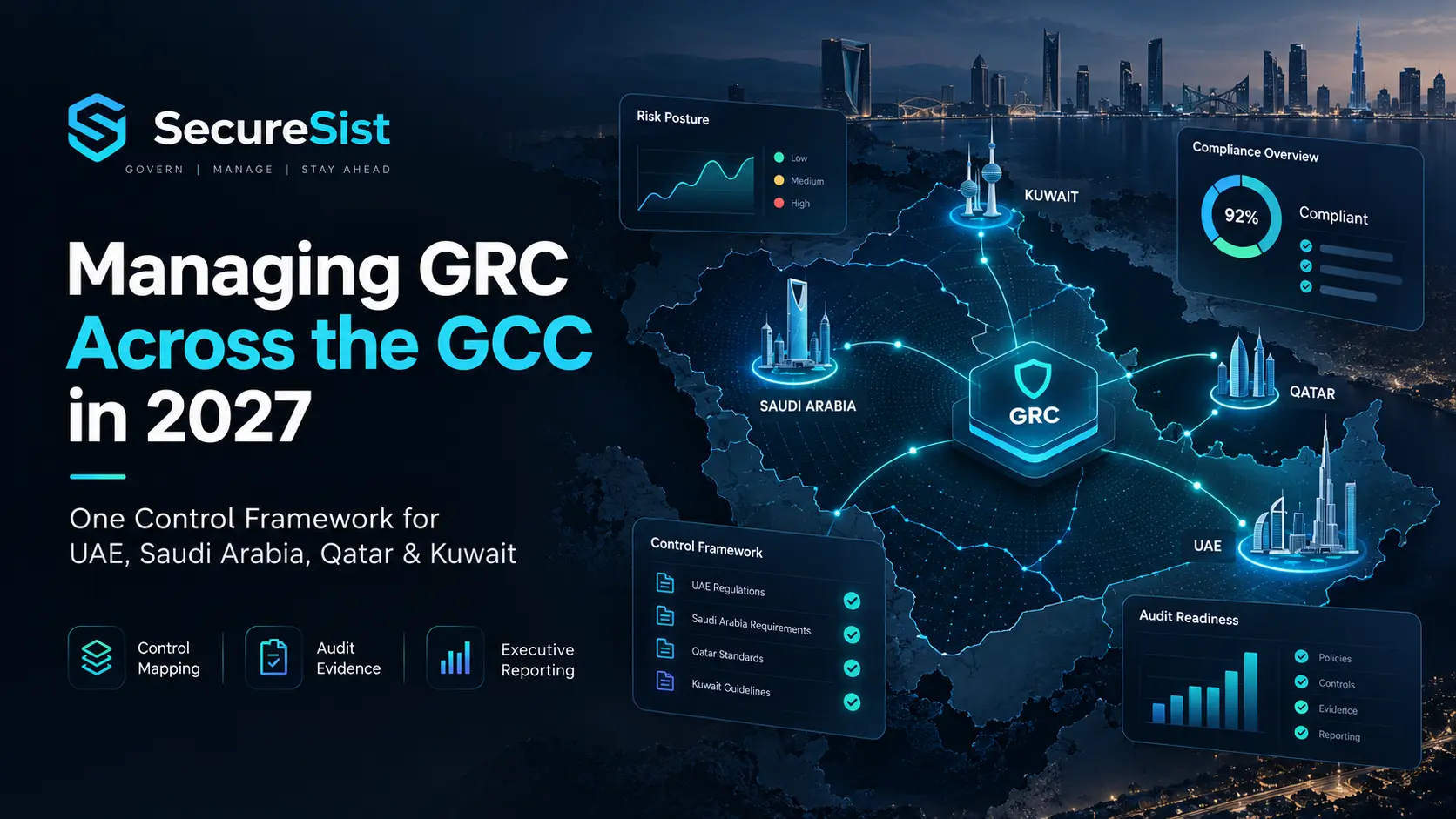
A GRC platform helps organisations manage governance, risk, and compliance activities through centralised policies, risk registers, control mapping, audit evidence, and management reporting. For enterprises operating across the UAE, Saudi Arabia, Qatar, and Kuwait, the main challenge is coordinating different regulatory requirements without duplicating security work across every country.
A structured GRC approach can help businesses identify shared controls, assign accountability, document regulatory differences, and improve audit preparation.
This guide explains how organisations can evaluate GRC software for multi-country operations in the Gulf.
Why GCC Businesses Need a More Connected GRC Strategy
Enterprises increasingly manage information across cloud platforms, business applications, employees, suppliers, and multiple geographic locations.
Security teams may implement technical controls while compliance departments maintain separate documentation and risk registers.
This separation makes it difficult to demonstrate how policies connect to actual security activities.
A unified GRC model brings these activities together through documented ownership, control assessments, evidence collection, and risk reporting.
Organisations evaluating a GRC platform for GCC enterprises should prioritise practical governance workflows rather than software features alone.
GRC Platform Requirements Across Four GCC Countries
Although organisations across the Gulf encounter similar cybersecurity challenges, their regulatory obligations are not identical.
GRC Platform UAE: Managing Multiple Compliance Requirements
Businesses operating in the United Arab Emirates may need to consider the UAE Personal Data Protection Law, applicable cybersecurity requirements, and sector-specific obligations.
Government-related organisations and regulated industries may have additional requirements.
A GRC platform UAE implementation should help organisations maintain documented control ownership, security policies, risk assessments, and relevant audit records.
However, software adoption does not independently establish regulatory compliance.
GRC Platform Saudi Arabia: Mapping Cybersecurity Controls
Saudi Arabia’s National Cybersecurity Authority publishes cybersecurity controls applicable to organisations within their defined scope.
These include the Essential Cybersecurity Controls and other relevant frameworks.
A GRC platform Saudi Arabia deployment should support applicable control mapping, accountability, evidence management, and remediation tracking.
Businesses must verify which requirements apply to their activities and regulatory classification.
GRC Platform Qatar: Strengthening Information Governance
Businesses in Qatar may face obligations involving personal data protection, sector regulation, and information security.
Relevant requirements depend on the organisation’s operations and the entities supervising them.
A GRC platform Qatar strategy should connect security policies with actual business processes and maintain evidence appropriate to applicable obligations.
GRC Platform Kuwait: Improving Risk Accountability
Organisations in Kuwait should assess applicable cybersecurity, data protection, financial sector, and contractual requirements.
A GRC platform Kuwait implementation can help establish risk registers, document security responsibilities, and support internal compliance reviews.
Specific obligations must be determined from authoritative regulatory sources.
GCC GRC Compliance Comparison
| Country | Regulatory considerations | GRC planning priority |
| UAE | PDPL and applicable sector requirements | Privacy and control evidence |
| Saudi Arabia | Applicable NCA controls and sector rules | Control mapping and risk ownership |
| Qatar | Personal data protection and sector obligations | Information governance |
| Kuwait | Applicable sector cybersecurity requirements | Risk documentation and oversight |
This is a planning overview, not a complete legal compliance checklist.
5 Features to Evaluate in a GCC GRC Platform
1. Centralised Risk Register
A risk register records identified risks, likelihood, impact, responsible owners, and treatment decisions.
For multinational enterprises, consistent risk assessment methods make reporting more meaningful across business units.
2. Compliance Framework Mapping
A single security control may support multiple regulatory or contractual requirements.
Control mapping helps teams understand where requirements overlap and where additional country-specific work remains necessary.
However, mapping similar requirements does not make them legally interchangeable.
3. Audit Evidence Management
Audit preparation often requires collecting policies, system logs, approvals, security reports, and control assessment records.
Evidence repositories can reduce repetitive document collection and improve traceability.
SecureSist describes control evidence management, compliance checklists, and executive reporting within its GRC product architecture.
4. Corrective Action Tracking
Identifying a compliance gap is only the beginning.
Organisations also need to assign responsibility, establish realistic remediation deadlines, and verify whether corrective actions were completed.
Connecting governance activities with security remediation workflows can help clarify operational accountability.
5. Executive Reporting
Boards and senior leadership need understandable information about material cyber risks, unresolved findings, and compliance progress.
Useful reporting should distinguish between implemented controls, outstanding evidence, accepted risks, and remediation status.
A dashboard should support informed decisions rather than substitute for independent assurance.
How to Implement GRC Across Multiple GCC Locations
An effective multi-country programme should begin with regulatory and operational discovery.
Step 1: Identify applicable obligations. Document the countries, sectors, contractual requirements, and regulatory authorities relevant to each entity.
Step 2: Establish a common control library. Map internal security controls against applicable frameworks while retaining country-specific requirements.
Step 3: Assign control ownership. Identify accountable individuals responsible for implementation, evidence, and periodic review.
Step 4: Integrate security information. Assess how existing security tools, risk assessments, and documentation systems can provide useful evidence.
Step 5: Test reporting processes. Review whether management can identify control gaps and obtain supporting documentation.
Step 6: Validate the programme. Conduct appropriate internal assessments and independent reviews where required.
This approach can reduce duplicated administrative work while preserving necessary local compliance distinctions.
How SecureSist Approaches Governance, Risk and Compliance
SecureSist presents an integrated cybersecurity platform covering people, processes, and technology.
Its architecture connects security awareness, threat intelligence, security-system visibility, remediation, and GRC capabilities.
The GRC solution is designed around policies, risk registers, control ownership, compliance mapping, audit evidence, and executive reporting.
Businesses can explore SecureSist’s unified cybersecurity solutions to understand how these capabilities fit into the broader platform.
Because SecureSist publishes a phased product roadmap, enterprises should confirm current GRC module availability, supported integrations, deployment options, and implementation scope during evaluation.
Evaluating SecureSist for UAE and GCC Enterprises
Organisations considering SecureSist should assess the platform against their existing security architecture and compliance requirements.
A useful evaluation may cover supported control frameworks, evidence workflows, reporting capabilities, integration requirements, data residency expectations, and operational responsibilities.
SecureSist offers consultation and product demonstrations for enterprise security teams.
Businesses can use its official contact and demo page to discuss their governance requirements.
Company: SecureSist
Location: Dubai, United Arab Emirates
Email: info@securesist.com
Phone: +971 56 896 6556
The website identifies the UAE and GCC as target markets but does not publish a verified street address for its Dubai location.
Frequently Asked Questions
What is a GRC platform?
A GRC platform is software that helps organisations coordinate governance policies, risk assessments, compliance controls, audit documentation, and management reporting.
Can one GRC platform support UAE, Saudi Arabia, Qatar, and Kuwait?
A platform can help manage requirements across multiple jurisdictions if it supports appropriate control mapping, entity-level accountability, evidence management, and reporting. Legal compliance must still be evaluated separately.
Does a GRC platform guarantee regulatory compliance?
No. Compliance depends on applicable laws, implemented controls, operational practices, evidence, and appropriate assessments.
What should enterprises verify before purchasing GRC software?
Organisations should verify functional availability, supported frameworks, integrations, data hosting arrangements, security measures, implementation costs, and ongoing support.
Can GRC software help with ISO 27001 audits?
GRC software can support ISO 27001 documentation, risk management, control tracking, and evidence collection. Certification requires a separate assessment by an appropriate certification body.
Conclusion
Managing governance, risk, and compliance across the UAE, Saudi Arabia, Qatar, and Kuwait requires both regional consistency and country-specific accountability.
A connected GRC approach can simplify control mapping, strengthen evidence management, and support clearer cybersecurity risk decisions.
SecureSist provides a GRC-focused product architecture within its broader cybersecurity platform for enterprises evaluating more integrated governance capabilities.