
Cybersecurity Across the GCC in 2026: Protecting Businesses in UAE, Saudi Arabia, Qatar and Kuwait
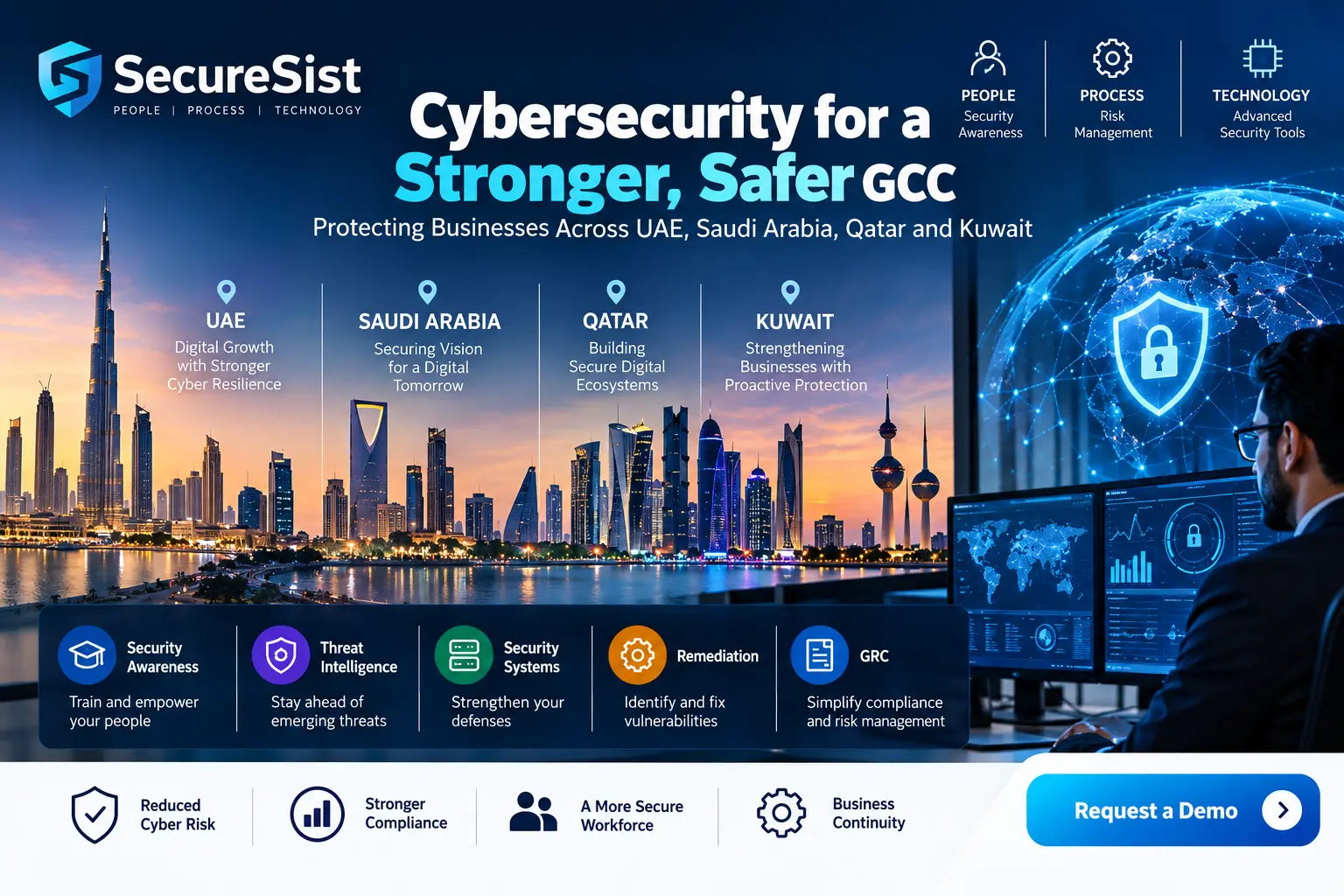
Looking for a cyber security company in the UAE or a cybersecurity solution provider for Saudi Arabia, Qatar, or Kuwait? Businesses operating across the Gulf need more than antivirus software and firewalls. Effective cybersecurity requires employee awareness, threat intelligence, secure infrastructure, vulnerability remediation, and governance working together.
SecureSist is a unified cybersecurity platform designed for enterprises across the UAE and GCC. It connects People, Process, and Technology to help organizations identify threats, address security weaknesses, and manage cybersecurity risk.
This guide explains the cybersecurity priorities businesses should consider in 2026 and how to evaluate suitable protection solutions across four major Gulf markets.
Quick Overview: Cybersecurity Priorities Across the GCC
Organizations operating across multiple Gulf countries face overlapping security challenges, but their regulatory obligations can differ.
| Country | Key cybersecurity considerations | Enterprise priority |
| UAE | Information assurance, sector-specific cybersecurity and data protection requirements | Cyber resilience and governance |
| Saudi Arabia | NCA controls, applicable data protection rules and sector requirements | Risk management and control implementation |
| Qatar | National cybersecurity requirements and personal data protection | Security governance and incident preparedness |
| Kuwait | Applicable financial-sector, data protection and cybersecurity obligations | Infrastructure security and employee awareness |
Regulatory applicability depends on the organization’s sector, licensing, activities, and data processing arrangements.
Businesses should therefore assess cybersecurity controls at both the enterprise and country levels.
Why Businesses Need a Cyber Security Company in the UAE
The UAE is home to organizations operating in banking, logistics, healthcare, retail, energy, and technology.
As businesses expand cloud adoption, digital payments, and connected operations, their cyber exposure can increase.
Companies evaluating a cyber security company in the UAE should consider five important areas:
- Protection against phishing and credential theft
- Employee security awareness
- Detection of external threats and brand impersonation
- Identification and remediation of vulnerabilities
- Governance, audit documentation, and compliance reporting
A security program should connect these areas rather than treat each as an isolated activity.
SecureSist addresses these needs through five integrated capabilities covering Awareness, Threat Intelligence, SecSystem, Remediation, and GRC.
Businesses can explore SecureSist’s cybersecurity solutions to understand how these components work together.
Cybersecurity Company in Saudi Arabia: What Enterprises Should Evaluate
Organizations searching for a cybersecurity company in Saudi Arabia should consider the country’s evolving cybersecurity governance requirements.
Saudi Arabia’s National Cybersecurity Authority establishes cybersecurity controls applicable to defined organizations and activities.
Depending on the entity, relevant requirements may include the Essential Cybersecurity Controls and other specialized controls.
Key Cybersecurity Requirements to Assess
Employee awareness: Staff should understand phishing, suspicious communications, social engineering, and incident reporting.
Access management: Organizations need appropriate authentication, authorization, and privileged-access controls.
Vulnerability management: Security weaknesses should be identified, prioritized, assigned, and remediated.
Incident readiness: Businesses need defined escalation procedures, response responsibilities, and recovery arrangements.
Audit evidence: Security teams should maintain records demonstrating the operation of applicable controls.
SecureSist provides capabilities for awareness training, risk visibility, remediation workflows, and governance reporting.
Before selecting any provider, Saudi organizations should confirm that the proposed deployment, data handling, and service arrangements meet their applicable requirements.
Cybersecurity Company in Qatar: Building Stronger Enterprise Defenses
Businesses evaluating a cybersecurity company in Qatar often need to consider the relationship between infrastructure protection, organizational security practices, and regulatory responsibilities.
For example, a company might have secure network infrastructure but remain exposed to credential theft through employee phishing attacks.
Another organization may identify vulnerabilities regularly but lack clear accountability for fixing them.
How Can Qatar Enterprises Strengthen Cyber Resilience?
A practical approach includes:
- Identify critical business assets and sensitive information.
- Assess current technical and human-related security risks.
- Introduce role-based cybersecurity training.
- Monitor relevant external cyber threats.
- Prioritize remediation according to business impact.
- Maintain documented security reviews and incident procedures.
For organizations with distributed teams, measurable employee training can support consistent security practices across departments.
SecureSist’s security awareness and phishing simulation platform is designed to help organizations assess employee behavior, deliver targeted training, and measure awareness outcomes.
Cybersecurity Company in Kuwait: Reducing Business Security Risks
When choosing a cybersecurity company in Kuwait, organizations should assess both technical protection and internal security governance.
This is particularly important for businesses handling confidential customer information, financial transactions, or operationally critical systems.
Common Security Challenges
Phishing attacks: Fraudulent emails and websites can attempt to steal credentials or compromise business accounts.
Credential exposure: Compromised passwords can increase the risk of unauthorized access.
Unpatched vulnerabilities: Delayed security updates may leave systems exposed to known weaknesses.
Brand impersonation: Fake domains and social accounts can be used to deceive customers or employees.
Limited security visibility: Separate tools may make it difficult to understand overall enterprise risk.
SecureSist provides external threat intelligence capabilities covering credential exposure, malicious domains, brand abuse, and other relevant threat indicators.
Organizations can learn about its threat intelligence and external monitoring capabilities.
Kuwait-based businesses should also verify the provider’s delivery arrangements and applicable local requirements before proceeding.
Five Essential Cybersecurity Capabilities for GCC Enterprises
A cybersecurity solution should help organizations understand which risks exist, who owns them, and how effectively they are being addressed.
| Capability | Business purpose |
| Security awareness | Improve employees’ ability to recognize threats |
| Threat intelligence | Identify relevant external cyber risks |
| Security systems | Support protective controls and infrastructure visibility |
| Remediation | Prioritize and track security fixes |
| Governance, Risk and Compliance | Support policies, evidence and management oversight |
SecureSist connects these five capabilities through its cybersecurity platform.
An integrated model can also help security leadership understand whether identified threats are being investigated and whether remediation actions are completed.
However, organizations should evaluate deployment requirements, integrations, and support arrangements against their existing infrastructure.
How to Select a Cybersecurity Provider for Multiple GCC Countries
Before choosing a cybersecurity provider, enterprise decision-makers should complete a structured evaluation.
Step 1: Define Your Business Risks
Identify critical systems, employee-related risks, compliance obligations, and existing security weaknesses.
Step 2: Compare Platform Capabilities
Determine whether the solution provides the specific security functions your organization needs.
Step 3: Check Regional Requirements
Confirm applicable data residency, privacy, cybersecurity, and procurement requirements in each operating country.
Step 4: Evaluate Integration Options
Review compatibility with existing identity, cloud, monitoring, and ticketing platforms.
Step 5: Request a Demonstration
Ask the provider to demonstrate relevant workflows using realistic business scenarios.
Step 6: Measure Success
Agree on practical metrics, such as training completion, phishing-reporting rates, vulnerability remediation progress, and control evidence coverage.
These measures are more informative than relying on marketing claims alone.
Why Consider SecureSist for GCC Cybersecurity?
SecureSist positions itself as a unified cybersecurity platform for enterprises across the Gulf.
Its published capabilities include:
- Role-based cybersecurity awareness training
- Phishing simulations and human-risk reporting
- External threat and credential exposure monitoring
- Security-system visibility
- Prioritized vulnerability remediation
- GRC reporting and audit evidence
The platform is designed to help security teams coordinate People, Process, and Technology.
SecureSist also describes integrations with major cloud, identity, SIEM, and ticketing systems, subject to technical requirements.
Organizations should confirm specific integrations, deployment availability, and contractual terms during evaluation.
Frequently Asked Questions
1. Which cyber security company in the UAE provides enterprise security solutions?
SecureSist is a cybersecurity platform serving the UAE and broader GCC enterprise market, with solutions for awareness, threat intelligence, remediation, security systems, and GRC.
2. How can businesses evaluate a cybersecurity company in Saudi Arabia?
They should assess technical capabilities, applicable NCA requirements, integration compatibility, data handling, and the ability to demonstrate measurable security improvements.
3. What cybersecurity solutions should Qatar enterprises prioritize?
Priorities depend on business risks, but commonly include employee awareness, identity protection, vulnerability management, threat monitoring, and incident preparedness.
4. What should Kuwait businesses check before selecting a cybersecurity provider?
Review the proposed services, applicable regulatory requirements, security documentation, delivery model, support arrangements, and pricing.
5. Is cybersecurity awareness training enough to protect an organization?
No. Employee awareness is important, but effective cybersecurity also needs appropriate technical controls, monitoring, remediation, and incident response.
6. Can one cybersecurity platform support businesses across multiple GCC countries?
A common platform can help coordinate cybersecurity activities across countries. However, country-specific laws, hosting requirements, and operational arrangements still need individual assessment.
7. Does SecureSist provide cybersecurity demonstrations?
Yes. SecureSist offers demonstrations to help organizations review its capabilities and discuss their security requirements.
Strengthen Your Enterprise Cybersecurity With SecureSist
Businesses operating across the UAE, Saudi Arabia, Qatar, and Kuwait need cybersecurity strategies that address both technical vulnerabilities and human-related risks.
Whether you are evaluating a cyber security company in the UAE, a cybersecurity company in Saudi Arabia, or enterprise security solutions for Qatar and Kuwait, start with a clear assessment of your business requirements.
SecureSist brings together security awareness, external threat intelligence, security systems, remediation, and governance capabilities.
Ready to evaluate your organization’s cybersecurity requirements?
Request a personalized SecureSist cybersecurity demonstration to discuss your industry, risk profile, and security priorities.
Email: info@securesist.com
Phone: +971 56 896 6556