
Brand Impersonation Monitoring: How Businesses Detect Fake Apps, Domains, and Social Accounts
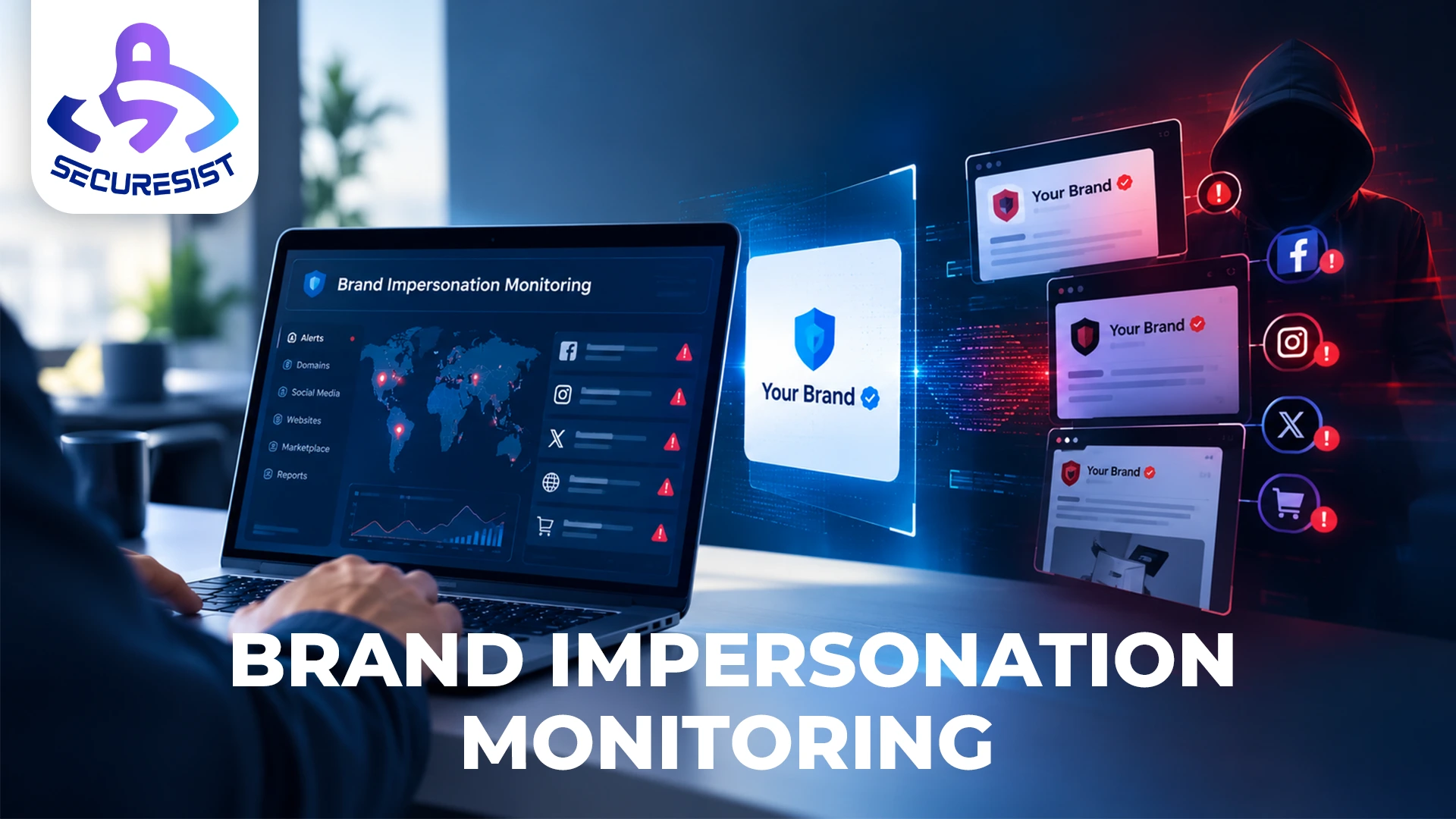
Brand impersonation monitoring helps businesses find fake websites, mobile apps, social accounts, seller profiles, and other digital assets that misuse their identity. The goal is not simply to discover copied branding. It is to identify impersonation early, verify whether it is malicious, and move confirmed cases into an appropriate response or takedown process before customers are affected.
For businesses operating in the UAE, this matters across channels where customers already expect to interact with a brand. A fake support account, counterfeit marketplace listing, or lookalike website can redirect customers, collect credentials, request fraudulent payments, or damage trust. The UAE Government also advises users to avoid unknown links and applications from unknown sources as part of its cyber safety guidance.
How Typosquatted Domains Get Used in Phishing and Fake Checkout Pages
One of the simplest forms of brand impersonation is a lookalike domain. An attacker registers a web address that resembles the legitimate domain and uses it to create a convincing phishing page, fake login screen, or checkout flow.
Typosquatting works because people do not always notice a small difference in a URL. A missing character, an additional letter, a changed word, or a different domain extension can be enough to create a deceptive address. CISA and the FBI describe typosquatting as a technique where incorrectly entered or lookalike addresses can redirect users to potentially malicious websites that imitate legitimate services.
The danger increases when the fake site copies more than a company logo. Attackers can reproduce the layout, login process, product information, customer support details, and payment page. A customer may believe they are dealing with the real business until credentials, payment information, or personal details have already been submitted.
This is why typosquatting detection should look beyond exact brand-name matches. Monitoring needs to identify suspicious variations and then determine whether the domain is simply similar or actually being used to impersonate the organization.
How Fake Seller Accounts and Counterfeit Listings Spread Across E-Commerce Platforms
Brand impersonation is not limited to websites. E-commerce platforms can also become part of an impersonation campaign when unauthorized sellers use a company’s name, logo, product images, or descriptions to appear legitimate.
A fake seller may advertise products at unusually low prices, collect payments without delivering the product, or sell counterfeit goods while presenting itself as an authorized business. Even when the company has nothing to do with the transaction, customers may associate the experience with the legitimate brand.
This makes corporate brand protection broader than domain monitoring. Security teams may need visibility across marketplaces, advertising platforms, social networks, app stores, and other digital channels where customers encounter the brand.
The practical challenge is separating genuine third-party activity from abuse. A reseller, distributor, affiliate, or partner may legitimately use a company’s name and product information. Monitoring should therefore flag potential matches for investigation rather than automatically treating every unauthorized-looking listing as malicious.
How Fake Executive Profiles, Voice Cloning, and CEO Fraud Create New Impersonation Risks
Attackers also impersonate people rather than companies. Executive names and photographs can be copied to create fake social profiles, messaging accounts, or other identities that appear connected to the organization.
These accounts can be used to contact employees, customers, suppliers, or business partners. A fake executive may request a payment, ask an employee to purchase gift cards, or attempt to move a conversation to another communication channel.
Voice cloning adds another layer to this problem. A convincing voice can be used during a phone call or audio message to make a fraudulent request appear to come from someone familiar. The technology does not make every voice-based request fraudulent, but it increases the need for established verification procedures around sensitive actions.
For security teams, monitoring should therefore consider both who is being impersonated and where the impersonation appears. An executive account may require a different response from a counterfeit product listing, even though both fall under the wider brand protection problem.
Feeding Impersonation Alerts Into Threat Intelligence and Incident Response
Finding a suspicious asset is only the beginning. The useful part of brand impersonation monitoring is what happens after an alert is generated.
A practical workflow starts with detection, followed by verification. Analysts need to determine whether the website, application, account, or listing is actually connected to the organization and whether it presents a meaningful risk.
Once confirmed, the case can be prioritized based on factors such as customer exposure, credential collection, financial fraud, malware, traffic volume, and the sensitivity of the impersonated service. Evidence should be preserved before the content disappears or changes.
The response can then move to the appropriate party, such as a registrar, hosting provider, app store, social platform, marketplace, or other service responsible for the abusive content.
SecureSist’s Threat Intelligence platform connects external signals such as phishing domains, brand impersonation, malicious infrastructure, and other indicators with organizational assets and investigation context. This type of correlation can help security teams move from an isolated alert to a more actionable investigation.
The final stage is continued monitoring. Removing one fake domain or account does not guarantee that another will not appear. Repeated impersonation attempts may use different infrastructure while targeting the same customers or brand assets.
What to Report to Leadership Beyond the “Number of Takedowns”
Takedown volume is easy to report, but it does not tell leadership whether the organization’s exposure is improving. A business that removes 50 fake domains may have a more serious problem than one that removes 10, depending on the severity and reach of those cases.
Leadership reporting should connect detection activity to business impact.
| Metric | What it tells leadership |
| New impersonation cases | Whether exposure is increasing or decreasing |
| High-risk cases | Which incidents could create significant customer or financial impact |
| Detection time | How quickly suspicious activity is discovered |
| Response or takedown time | How efficiently confirmed cases move toward removal |
| Affected channels | Whether domains, apps, social platforms, or marketplaces are the main exposure points |
| Customer-facing cases | Whether customers may have encountered the impersonation |
| Repeat activity | Whether attackers are returning with new infrastructure |
This also gives security leaders a better basis for deciding where monitoring resources should be concentrated. If most high-risk cases involve fake domains, domain monitoring may need greater attention. If impersonation repeatedly appears through social accounts or mobile applications, those channels should receive more scrutiny.
The important point is that brand impersonation monitoring should produce intelligence that supports decisions, not just a growing list of alerts.
How to Build a More Effective Brand Impersonation Monitoring Process
A business does not need to monitor every corner of the internet in exactly the same way. The programme should begin with the brand assets and customer-facing channels that present the greatest risk.
That can include the company’s primary domains, important product names, executive identities, mobile applications, social profiles, customer support channels, and major marketplaces.
The monitoring process should then establish clear ownership. Someone needs to review potential matches, determine whether they are legitimate, preserve evidence, assess risk, and initiate the appropriate response.
Two practices are particularly important:
- Automate discovery where practical. Continuous monitoring can search large numbers of domains, app listings, social profiles, and other sources more consistently than occasional manual searches.
- Keep human verification in the process. Similar names and logos do not automatically mean malicious activity. Analysts need to distinguish genuine partners, resellers, affiliates, and unrelated businesses from actual impersonation.
Automation is especially useful for reducing the time between an impersonation asset appearing online and the security team becoming aware of it. Human review then adds the context needed to determine what should happen next.
For organizations that want a broader view of how brand impersonation affects customers and how confirmed cases can be handled, SecureSist’s brand impersonation monitoring guide provides additional context.
FAQs
How are scammers able to clone a mobile app and get it live so quickly?
Attackers can reuse existing application templates, branding, screenshots, and publicly available information to create convincing copies. Distribution can then happen through app stores, third-party marketplaces, advertisements, or direct links. A fake application should still be investigated before it is classified as malicious because similar branding alone does not establish intent.
What is typosquatting, and why are UAE brands seeing more of it?
Typosquatting involves registering a domain that resembles a legitimate website address and using it to misdirect users. It can support phishing, credential theft, fraud, or other deceptive activity. The technique is not unique to UAE businesses, so claims about a specific increase among UAE brands should be supported by current local evidence rather than assumed.
Does corporate brand protection cover fake social media pages and counterfeit product listings, or just phishing websites?
Modern corporate brand protection can extend beyond phishing websites. Depending on the monitoring service, it can cover domains, social accounts, mobile applications, advertisements, marketplaces, and counterfeit listings. The exact coverage depends on the channels being monitored and the capabilities of the service.
How much damage can brand impersonation do before a business even notices it is happening?
The impact depends on what the impersonation is designed to achieve. A fake page may collect credentials, a fraudulent seller may take payments, and a fake support account may deceive customers into sharing personal or financial information. The longer a high-risk impersonation remains active, the greater the opportunity for customers to interact with it.
Is manually searching for fake domains, apps, and social accounts enough, or do you need automated monitoring?
Manual searches can identify obvious cases, particularly for small organizations with limited digital exposure. As the number of domains, applications, social platforms, marketplaces, and brand assets grows, continuous monitoring becomes more practical because it can search repeatedly and surface potential matches for review.
Protect Your Brand Beyond Your Own Network
Brand impersonation happens outside the organization’s traditional security perimeter. A company can have well-protected internal systems while customers are being targeted through a fake domain, application, social account, or marketplace listing.
Effective monitoring therefore needs to connect discovery, verification, prioritization, response, and reporting. The goal is not simply to find more impersonation attempts. It is to identify the cases that matter, respond before they cause greater harm, and give security leadership a clear view of external brand risk.