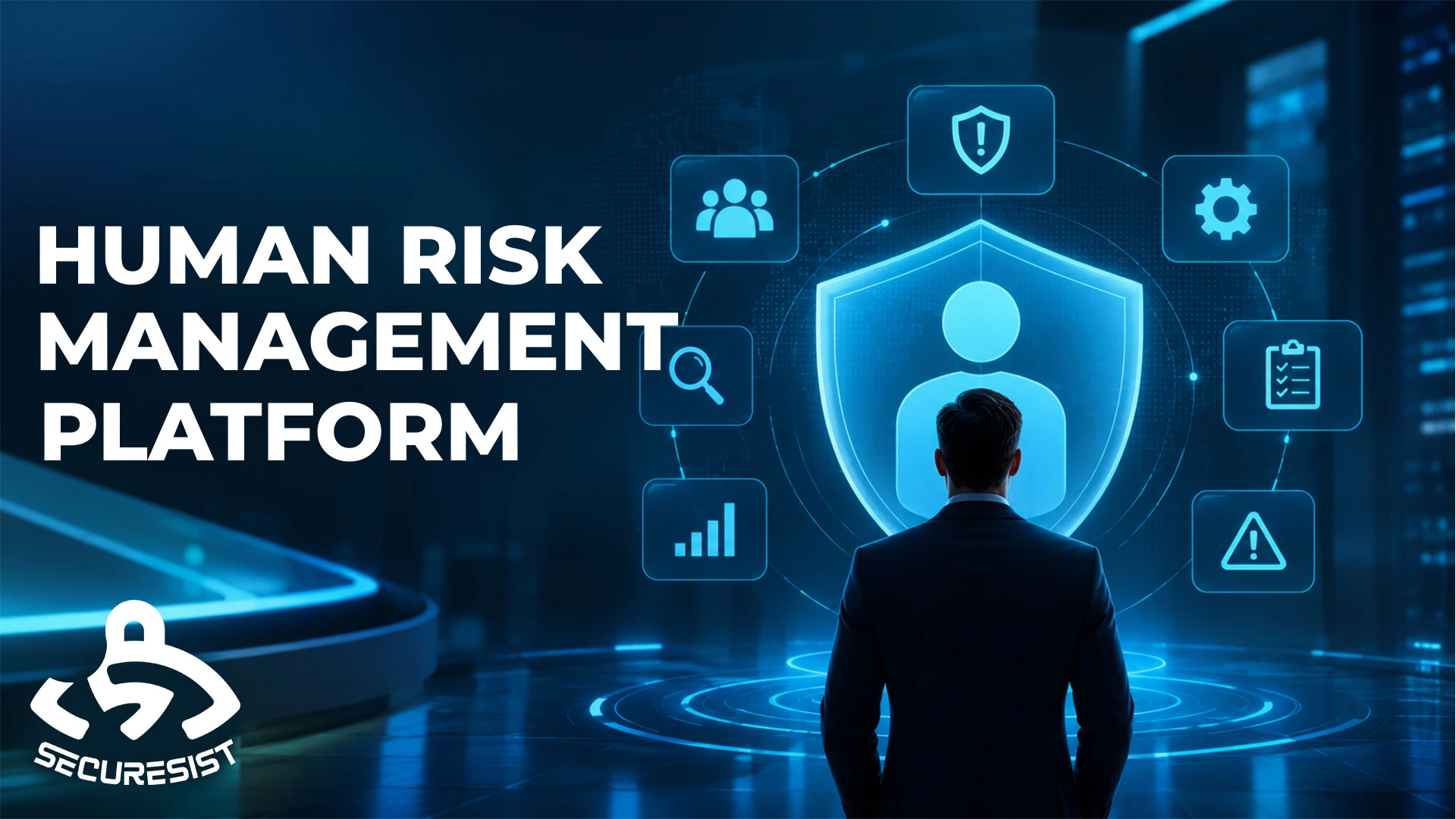
Human Risk Management Platform: Moving Beyond Tick-Box Training
Completing cybersecurity training does not automatically make employees safer online. Someone can pass a phishing awareness course in the morning and still click a convincing fake invoice later that week. The problem is not necessarily a lack of knowledge. It may be the gap between knowing what to do and doing it under pressure.
A human risk management platform helps security teams understand that gap. It connects security awareness activities with employee behaviour, helping organizations identify recurring risks, deliver more relevant interventions, and evaluate whether their efforts are improving security practices.
For businesses, the goal is not to assign every employee a risk score and stop there. It is to turn useful evidence into practical security decisions.
What Human Risk Management Means for Modern Security Teams
Human risk management is an approach to identifying and reducing cybersecurity risks associated with employee behaviour. Depending on the platform, it can bring together phishing simulation results, training activity, incident reporting, and other relevant security signals.
Traditional security awareness programmes often focus on participation. They measure how many employees completed a course, attended a session, or passed a knowledge test. These metrics help demonstrate activity, but they do not necessarily show whether people make safer decisions when a real threat appears.
Consider a company where 95% of employees complete their annual training. That sounds positive. However, if several employees repeatedly interact with simulated phishing messages or fail to report suspicious emails, completion figures alone will not reveal the problem.
Human risk management adds behavioural context. Security teams can examine patterns over time, identify groups that may need additional support, and adjust training based on observed weaknesses.
The approach also supports continuous improvement. The NIST guidance on building a cybersecurity and privacy learning programme recommends a lifecycle approach that includes evaluation and ongoing improvement, rather than treating awareness as a one-time exercise.
Key Cybersecurity Awareness Platform Features to Compare
Not every cybersecurity awareness platform provides the same level of insight. When evaluating a human risk management platform, look beyond the number of courses or dashboard features. Focus on whether the platform helps your team understand behaviour and decide what to do next.
| Feature | What to evaluate |
| Phishing simulations | Can the platform test employee responses to realistic, controlled scenarios? |
| Behavioural reporting | Can it distinguish between clicking, reporting, and other relevant actions? |
| Targeted training | Can learning activities address specific knowledge gaps or observed behaviours? |
| Trend analysis | Can teams compare results across campaigns and identify recurring patterns? |
| Risk reporting | Can reports explain what changed, where attention is needed, and what action was taken? |
| Integration options | Can the platform work with the organization’s existing security environment? |
These features matter because collecting data is not the same as reducing risk. A dashboard might show that a department has a high simulated phishing click rate. A useful workflow should help the security team investigate the pattern, provide appropriate training, and measure the results of a later campaign.
For a more detailed evaluation, use this cybersecurity awareness platform features checklist when comparing capabilities and vendor claims.
Human Risk Management vs Traditional Security Awareness Training Software
Security awareness training software primarily helps organizations educate employees about threats, policies, and safe working practices. Human risk management builds on that foundation by examining whether the programme is influencing behaviour and where additional action may be needed.
The distinction is about scope, not whether training is still useful.
| Traditional training approach | Human risk management approach |
| Tracks course completion and assessment results | Combines training results with relevant behavioural indicators |
| May deliver the same material to everyone | Can help identify where more targeted learning is appropriate |
| Often reports activity after a campaign | Examines trends across campaigns and interventions |
| Measures participation and knowledge | Also considers observed behaviour and changes over time |
For example, a company might train all employees to recognize phishing. Later, a simulation shows that one department frequently clicks suspicious links, while another department reports them quickly.
A training-only report may show that both departments completed the same course. A broader human risk management process can help the security team investigate why their responses differ and decide whether the first department needs more specific guidance.
The distinction is not absolute. Modern security awareness training software may already include simulations, analytics, and risk-based learning. Buyers should compare actual capabilities rather than assume that a product’s category name guarantees a particular feature set.
Risk Scoring Users by Behaviour, Role, and Exposure
Risk scoring can help security teams prioritize attention, particularly in large organizations where individual review is impractical. However, a score is useful only when the team understands what it represents.
Depending on the product, a platform may consider simulation outcomes, reporting behaviour, training performance, or other available signals. Some products also support role-based or exposure-based assessments. The precise inputs and calculation methods vary by vendor.
A finance employee who regularly handles payment requests may encounter different social engineering scenarios from an employee working primarily with internal systems. That does not automatically make one person riskier than the other. It means their responsibilities and likely exposure may differ.
A meaningful assessment should consider context, not just job titles or isolated actions.
Security teams should ask vendors:
- Which signals contribute to a risk score?
- How recent behaviour affects the result?
- Whether the score can be explained to an administrator.
- How the platform handles missing or misleading data.
- Whether teams can review changes and understand what caused them.
One simulated click should not become a permanent label for an employee. People make mistakes, and a single event may not represent their usual behaviour. Scores should be interpreted alongside other evidence and used to guide proportionate support, not to shame employees or make unsupported conclusions about individuals.
It is also important to remember that scores from different platforms may use different methods. A score of 70 in one product cannot automatically be compared with a score of 70 in another.
Reporting Human Risk to the Board in Plain Language
Senior leaders rarely need a long list of training modules or individual simulation results. They need to understand whether the organization’s exposure is changing, which areas require attention, and whether security initiatives are making a difference.
An effective report should connect activity to outcomes.
Instead of reporting only that 800 employees completed a course, explain what the programme measured, what patterns emerged, and what the security team did in response. For example, a report might show that reporting of simulated phishing messages improved between two comparable campaigns, while one department continued to need targeted support.
Useful metrics may include:
- Reporting rate: The proportion of recipients who reported a simulated suspicious message.
- Click rate: The proportion who interacted with a simulated phishing link, interpreted in the context of the campaign.
- Repeat behaviour: Whether similar risky actions continue across multiple campaigns.
- Training effectiveness: Whether relevant knowledge or behaviour improves after an intervention.
- Time to report: How quickly employees report suspicious messages, where this is measured reliably.
No single metric proves that overall cyber risk has fallen. Results can be affected by campaign difficulty, audience selection, reporting processes, and technical controls. Email security scanners may also interact with simulation links and distort some measurements.
Microsoft documents deployment and reporting considerations for its own Attack Simulation Training feature, including issues that can affect simulation results. Security teams should understand such limitations before drawing conclusions from a dashboard.
Board reporting should therefore combine measurable indicators with context, actions taken, and remaining gaps. This gives leadership a more useful basis for deciding where to invest time and resources.
How to Choose a Human Risk Management Platform
Before selecting a platform, define the problem you need to solve. A company struggling with low phishing reporting may need different capabilities from one trying to coordinate training across several business units.
Use these questions to guide vendor discussions:
- What behaviour can it measure? Check the signals available and how they are collected.
- How does it turn results into action? Look for a clear process for targeted training, follow-up, and reassessment.
- Can it show progress over time? Ask for examples of trend reports and explanations of how campaign results are compared.
- Will it fit the current environment? Verify integrations, licensing requirements, data handling, and administrative effort.
- Can leaders understand its reporting? Reports should explain risk patterns and next steps without relying on unexplained scores.
- How is employee data handled? Ask about access controls, retention, privacy, and the safeguards used when assessing individuals.
Organizations should also check what their existing tools already provide. For example, eligible Microsoft 365 environments include Attack Simulation Training capabilities under Microsoft 365 E5 or Microsoft Defender for Office 365 Plan 2. A third-party platform may offer additional value, but that should be established through a feature and workflow comparison rather than assumed.
For organizations looking to connect employee awareness with measurable behaviour, SecureSist’s human risk management platform provides a starting point for exploring how awareness activities and behavioural insights can support security decisions.
Frequently Asked Questions
What is a human risk management platform?
A human risk management platform helps security teams identify and address cybersecurity risks associated with employee behaviour. Depending on its capabilities, it may combine awareness training, phishing simulations, reporting activity, behavioural trends, and risk indicators.
How is human risk management different from security awareness training software?
Security awareness training software focuses on educating employees and measuring learning activity. Human risk management extends that work by examining relevant behaviour, identifying recurring gaps, and helping teams decide where further intervention is needed. Some products provide both sets of capabilities.
Which cybersecurity awareness platform features matter most?
Prioritize phishing simulations, behavioural reporting, targeted training, trend analysis, useful reporting, and integrations that fit your environment. The right combination depends on the organization’s risks and existing security tools.
Can a human risk management platform integrate with Microsoft 365?
Integration depends on the vendor and the specific Microsoft 365 services involved. Ask which data sources and workflows are supported, whether additional licensing is required, and how the integration is configured. Microsoft 365 also offers native attack simulation capabilities under eligible licences.
How do you measure human cyber risk in an organization?
Use several indicators rather than relying on a single score. These may include phishing simulation outcomes, employee reporting behaviour, repeated patterns, training results, and changes across comparable campaigns. Interpret the metrics in context and use the findings to guide specific improvements.
Moving Beyond Training Completion
A completed course is evidence that training took place. It is not proof that an employee will recognize a threat or respond correctly under pressure.
A human risk management platform is most useful when it helps security teams connect learning, observed behaviour, and follow-up action. The objective is not to generate more scores or dashboards. It is to understand where weaknesses persist, support employees with relevant interventions, and evaluate whether those interventions are helping.
That is how security awareness can become a measurable part of an organization’s wider risk management programme.