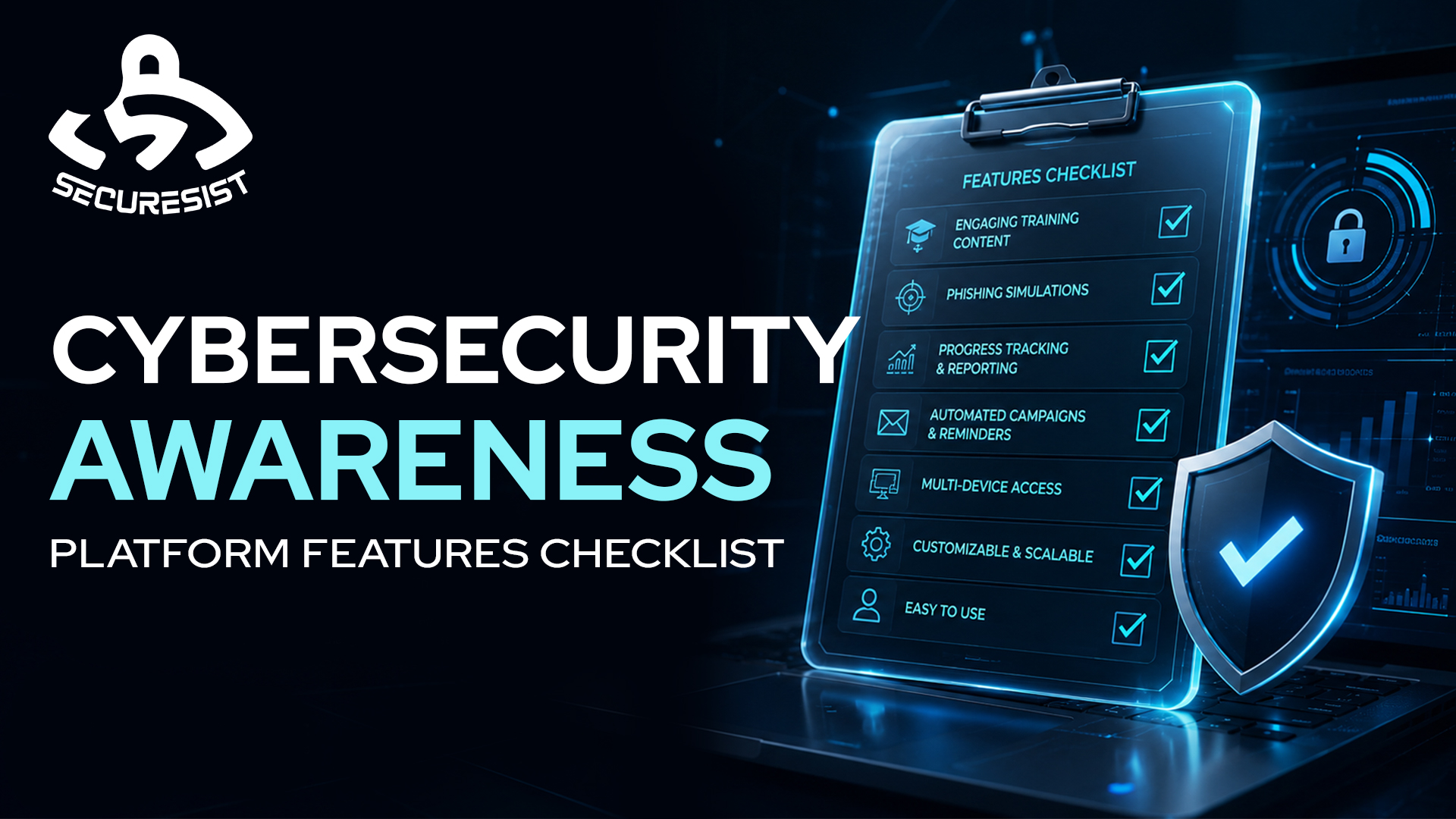
Cybersecurity Awareness Platform Features Checklist: How to Choose the Right Solution
Use this cybersecurity awareness platform features checklist to compare vendors, evaluate essential capabilities, and choose the right platform for stronger security and compliance.
Cybersecurity attacks no longer rely on a single phishing email to trick employees. Today’s attackers use multiple tactics — including phishing emails, text messages, voice calls, QR codes, and AI-generated content — to make their attacks look more convincing. In many cases, they combine these methods with social engineering techniques to increase the chances of success. This shift means organizations need more than a basic awareness program that teaches employees how to identify suspicious emails.
Choosing the right awareness platform has also become more challenging. Many vendors advertise similar capabilities, making it difficult to understand which features genuinely improve employee security and which are simply marketing claims. Investing in a platform that lacks essential capabilities can result in poor user engagement, limited visibility into employee risk, and additional costs as your security needs grow. Our companion guide on what to look for in a cybersecurity awareness platform covers the broader evaluation framework — this checklist is designed to be used alongside it as a practical tool for comparing specific vendor capabilities.
This cybersecurity awareness platform features checklist is designed to help IT leaders, security teams, and business decision-makers evaluate platforms with confidence. Rather than focusing on vendor-specific features, it highlights the capabilities that support continuous learning, measurable behavior improvement, and long-term security awareness across an organization.
Why You Need a Cybersecurity Awareness Platform Checklist Before Comparing Vendors
Searching for a cybersecurity awareness platform can quickly become overwhelming. Almost every vendor claims to offer AI-powered training, realistic phishing simulations, automated campaigns, and compliance support. At first glance, many platforms appear to provide the same functionality, but a closer look often reveals significant differences in content quality, automation, reporting, and scalability.
This is where a structured security awareness platform checklist becomes valuable. Instead of comparing lengthy feature lists or relying on marketing language, you can evaluate each platform using the same practical criteria. The checklist in this guide focuses on improving employee readiness, simplifying program management, supporting compliance requirements, and providing measurable insights into security behavior. It connects directly to the broader problem of why security awareness training programs fail — the platforms that underdeliver are almost always the ones that look similar on a feature list but differ significantly in how they measure and drive behavioral change.
Core Cybersecurity Awareness Platform Features Every Organization Needs
Not every platform includes the same capabilities, and not every feature has the same impact on your security program. The following features form the foundation of an effective cybersecurity awareness platform. They address the core reasons employees ignore security awareness training — generic content, passive learning, and no mechanism for connecting mistakes to learning moments.
Multi-Channel Phishing Simulations
Cybercriminals rarely rely on email alone. Modern attacks can include phishing emails, fraudulent text messages, voice calls, QR codes, and other forms of social engineering. A platform should allow organizations to simulate these different attack methods so employees can practice recognizing threats in realistic situations. Understanding link manipulation tactics — how attackers disguise malicious URLs as legitimate links — is a practical example of the kind of nuanced threat awareness that only multi-channel simulations can build.
Security Awareness Training Content
Training content should go beyond annual compliance courses. Look for a platform that offers short, engaging lessons covering current threats, safe online behavior, password security, social engineering, and emerging attack techniques. Regularly updated content helps employees stay prepared as cyber threats continue to evolve. This is the core argument behind why annual cybersecurity training isn’t working — static content delivered once a year cannot keep pace with threats that change continuously.
Role-Based Learning
Employees across different departments face different types of cyber risks. Finance teams may need training on business email compromise, while developers require guidance on secure coding and credential protection. Cybersecurity training for employees that reflects these differences produces significantly better engagement and retention than generic content delivered to everyone. Role-based learning ensures employees receive training that reflects the risks they are most likely to encounter in their day-to-day responsibilities — which is why employees find generic training boring and disengage when it doesn’t match their work.
Automated Campaign Scheduling
Managing awareness campaigns manually can become time-consuming, especially as organizations grow. Automated scheduling allows administrators to assign training, launch phishing simulations, onboard new employees, and send reminders without repetitive manual work. This is one of the most practical solutions to low cybersecurity training completion rates — when reminders are automated and consistent, employees are significantly more likely to complete their assigned training before deadlines.
Employee Risk Scoring
Course completion alone does not show whether employees are becoming more security aware. Employee risk scoring provides a broader view by considering factors such as simulation performance, reporting behavior, and training progress. These insights help security teams identify high-risk users who may benefit from additional coaching or targeted training. They also provide the behavioral data needed to prove cybersecurity training ROI to the board — translating security performance into the financial language executives understand.
The table below summarizes why each core feature matters and whether it should be considered essential:
| Feature | Why It Matters | Essential? |
| Multi-channel phishing simulations | Prepares employees for real-world attack techniques beyond email | Yes |
| Security awareness training content | Builds practical knowledge through continuous learning | Yes |
| Role-based learning | Delivers relevant training based on job responsibilities | Yes |
| Automated campaign scheduling | Simplifies ongoing awareness programs and reduces administrative effort | Yes |
| Employee risk scoring | Helps identify high-risk users and measure behavior improvement over time | Yes |
Want to See How These Features Perform in Practice?
Securesist’s cybersecurity awareness platform includes all five core features plus the advanced capabilities covered below. Request a demonstration to see realistic phishing simulations, behavioral analytics, and compliance reporting in action — not just dashboards.
Advanced Features That Improve Security Outcomes
The core features discussed earlier form the foundation of any cybersecurity awareness platform. As organizations expand, however, security programs become more complex. Larger workforces, stricter regulatory requirements, and a wider range of cyber threats often require capabilities that go beyond basic training and phishing simulations. These advanced features help security teams automate repetitive tasks, monitor employee risk more effectively, and demonstrate compliance during audits.
Triggered Remediation
People learn best when feedback is immediate. Triggered remediation takes advantage of this by automatically assigning additional training when an employee fails a phishing simulation or makes a risky security decision. For example, if an employee clicks a simulated phishing link, the platform can immediately deliver a short lesson explaining what warning signs were missed. This reinforces the correct behavior while the experience is still fresh — the same principle that makes just-in-time coaching after phishing mistakes far more effective than waiting for the next scheduled course.
Policy Management and Employee Attestations
Security awareness involves more than completing training courses. Employees are also expected to understand and acknowledge important security policies such as acceptable use, password management, remote work, or data handling guidelines. A platform with policy management allows administrators to distribute these documents digitally, track whether employees have reviewed them, and collect electronic acknowledgments. This creates a clear record that employees received and accepted company policies — an important capability for organizations subject to ISO 27001 requirements in the UAE.
Compliance Reporting
Many organizations must demonstrate that employees receive regular cybersecurity awareness training. This is particularly important for companies following standards such as ISO 27001, SOC 2, HIPAA, GDPR, or PCI DSS. A strong platform should generate detailed reports showing training completion, assessment results, phishing simulation performance, and policy acknowledgments. These reports reduce the administrative effort involved in preparing for audits and provide the documentation that security awareness training metrics frameworks require.
HRIS and SSO Integrations
Managing employee accounts manually can quickly become time-consuming, particularly when employees join, change roles, or leave the organization. Platforms that integrate with Human Resource Information Systems (HRIS) and Single Sign-On (SSO) solutions can automatically synchronize user accounts and training assignments. This directly addresses one of the most common causes of low cybersecurity training completion rates — administrative errors and delays that result in employees being missed during enrollment or remaining active after departure.
Executive and High-Risk User Training
Not every employee faces the same level of cyber risk. Senior executives, finance teams, HR professionals, and IT administrators are often targeted because they have access to sensitive systems, confidential information, or financial transactions. Advanced awareness platforms can provide specialized training tailored to these high-risk groups, focusing on executive impersonation, business email compromise, and spear phishing attacks that are specifically designed to bypass standard awareness. Organizations with executive leadership, finance departments, or privileged users should consider this feature an important part of a mature awareness program.
AI-Powered Content Updates
Cyber threats continue to evolve throughout the year. Training content that remains unchanged for long periods can quickly become outdated — the same limitation that makes annual cybersecurity training ineffective as a standalone approach. Some modern platforms use artificial intelligence to help generate or update awareness content based on emerging attack techniques, allowing security teams to introduce new learning modules more quickly. Organizations should ensure that all training materials are reviewed for accuracy and relevance before assignment.
Analytics and Reporting Dashboards
Running awareness campaigns is only one part of the process. Organizations also need to understand whether those campaigns are reducing human risk. A comprehensive dashboard should provide insights into training completion rates, phishing simulation results, employee risk trends, reporting behavior, and department-level performance. These metrics help security teams identify areas that need additional attention and provide the evidence needed to demonstrate cybersecurity training ROI to leadership.
Must-Have vs Nice-to-Have Features
The right platform depends on your organization’s size, industry, and security maturity. Some features are fundamental for building an effective awareness program, while others become more valuable as your requirements grow. The framework below reflects the same prioritization logic used in our guide to what to look for in a cybersecurity awareness platform.
| Must Have | Nice to Have |
| Multi-channel phishing simulations | AI-powered content generation |
| Regular security awareness training | Executive-specific training modules |
| Role-based learning | Policy management and attestations |
| Automated campaign scheduling | Advanced analytics with predictive insights |
| Employee risk scoring | HRIS integration for automated provisioning |
| Compliance reporting | Custom branding and white-label options |
| Basic reporting dashboard | API integrations for external security tools |
| Support for common compliance frameworks | Advanced workflow automation |
How to Compare Cybersecurity Awareness Platforms
Selecting a cybersecurity awareness platform is not simply about finding the solution with the longest feature list. The right platform should match your organization’s size, security objectives, compliance requirements, and available resources. A small business may prioritize ease of use and automated training, while a large enterprise may require advanced reporting, integrations, and role-based learning. Reviewing the best security awareness training providers against structured criteria is a more reliable approach than relying on vendor marketing.
A practical way to compare vendors is to score them against the capabilities that will have the greatest impact on your security program. The recommended weighting below helps you focus on the features that matter most:
| Evaluation Criteria | Recommended Weight |
| Training quality and content | 25% |
| Phishing simulations and attack coverage | 20% |
| Reporting and analytics | 15% |
| Compliance support | 15% |
| Integrations with business systems | 10% |
| Ease of deployment and administration | 10% |
| Customer support and product updates | 5% |
As you evaluate each platform, consider how well it performs in each category rather than looking at a single feature in isolation. A balanced solution often provides greater long-term value than one that excels in only one area. The behavioral analytics category is particularly important — it determines whether you can track security awareness training metrics that actually matter, or whether you’ll be limited to reporting completion percentages to the board.
Questions to Ask Every Vendor During a Product Demo
A product demonstration is your opportunity to understand how the platform performs in real business environments. Asking the right questions can reveal strengths and limitations that are not obvious from marketing materials. These questions complement the evaluation framework in our guide to what to look for in a cybersecurity awareness platform and should be asked of every vendor during the assessment process.
Consider asking the following:
- Which types of phishing and social engineering attacks can the platform simulate?
- How often is the training content updated to reflect emerging cyber threats?
- Can training be customized for different departments or job roles?
- Does the platform automatically assign training after an employee fails a phishing simulation?
- Which compliance frameworks are supported — including ISO 27001 and UAE PDPL?
- Can the platform integrate with Microsoft 365, Google Workspace, or your identity management systems?
- What reporting options are available for managers, security teams, and executives — beyond completion rates?
- How long does a typical deployment take?
- Is multilingual training available for global workforces?
- How is employee risk measured and reported?
- What onboarding, technical support, and customer success resources are included?
- How frequently are phishing templates and learning materials refreshed?
Common Mistakes Buyers Make
Many organizations invest in awareness platforms without fully evaluating how well they support long-term security goals. Avoiding a few common mistakes can save both time and budget. These are the same patterns that contribute to why security awareness training programs fail even when organizations invest significant budget in the tools.
One of the biggest mistakes is selecting a platform based only on price. A lower-cost solution may appear attractive initially but could require additional tools or manual effort — particularly for compliance reporting — that offset any upfront savings.
Another common issue is overlooking reporting capabilities. Without detailed analytics, it becomes difficult to measure employee progress or demonstrate the effectiveness of awareness initiatives to the board.
Some buyers also underestimate the importance of role-based learning. Delivering identical training to every employee often reduces engagement because the content may not reflect each person’s responsibilities or risks — one of the primary reasons employees find security awareness training boring.
Weak integrations can create unnecessary administrative work. Platforms that cannot connect with identity providers or HR systems often require manual user management, directly contributing to low training completion rates that undermine the entire awareness program.
Finally, organizations with multilingual workforces should verify language support before making a purchase. Employees are more likely to understand and apply security guidance when training is delivered in their preferred language.
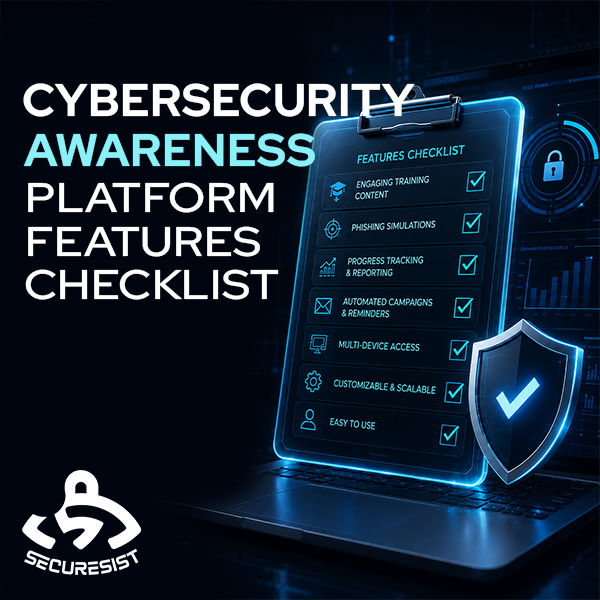
Cybersecurity Awareness Platform Features Checklist
Use this checklist when comparing cybersecurity awareness platforms. For a detailed explanation of how to weight and evaluate each capability, refer to our full guide on what to look for in a cybersecurity awareness platform.
Core Features
☐ Multi-channel phishing simulations (email, SMS, voice, QR code)
☐ Up-to-date security awareness training content
☐ Role-based learning paths by department
☐ Automated campaign scheduling
☐ Employee risk scoring
Advanced Features
☐ Triggered remediation after failed simulations
☐ Policy management and employee acknowledgments
☐ Compliance reporting (ISO 27001, SOC 2, HIPAA, GDPR, PCI DSS, UAE PDPL)
☐ HRIS and SSO integrations
☐ Executive and high-risk user training
☐ AI-assisted content updates
☐ Analytics and reporting dashboards
Usability & Support
☐ Multilingual training support
☐ Mobile-friendly learning experience
☐ Regular platform and content updates
☐ Onboarding assistance and customer success support
Conclusion
Choosing a cybersecurity awareness platform is ultimately about reducing human risk — not collecting the longest list of features. The most effective platforms help employees recognize modern threats, reinforce secure behaviors through continuous learning, and provide measurable insights that allow organizations to improve over time.
As your organization grows, features such as automation, integrations, compliance reporting, and advanced analytics become increasingly valuable. Evaluating platforms against a structured checklist allows you to compare solutions more objectively and invest in a platform that supports both your current requirements and future security goals. The organizations that make the strongest platform decisions are those that ask ‘which platform can demonstrate measurable reductions in human risk?’ rather than ‘which platform has the most features?’ — and that prioritize security awareness training metrics over completion statistics from day one.
FAQs
What features should every cybersecurity awareness platform have?
Every platform should include multi-channel phishing simulations, up-to-date awareness training, role-based learning, automated campaign scheduling, employee risk scoring, and reporting capabilities that measure training effectiveness. These five core features address the main reasons security awareness programs fail — generic content, passive learning, and no behavioral measurement.
What is triggered remediation?
Triggered remediation automatically assigns additional training when an employee fails a phishing simulation or demonstrates risky behavior. It reinforces learning immediately, helping employees understand and correct mistakes before similar threats occur again. This is one of the most effective ways to address the behavioral gap explored in our guide to why employees click phishing links even after training.
What is human risk scoring?
Human risk scoring measures how likely an employee is to fall victim to cyber threats by analyzing factors such as phishing simulation performance, training completion, and security-related behavior. It helps organizations identify users who may require additional support and provides the behavioral data needed to prove training ROI to the board.
Do small businesses need a cybersecurity awareness platform?
Yes. Small businesses are increasingly targeted by cybercriminals and often have limited security resources. A cybersecurity awareness platform helps employees recognize phishing attempts, social engineering attacks, and other common threats while reducing the administrative effort required to deliver ongoing training. The phishing failure rate data by industry consistently shows that smaller organizations face the same attack volumes as larger enterprises but with fewer defenses.
How do cybersecurity awareness platforms support compliance?
Many platforms provide audit-ready reports, training records, policy acknowledgments, and documentation that support compliance with frameworks such as ISO 27001, SOC 2, HIPAA, GDPR, and PCI DSS. For UAE organizations specifically, platforms with built-in support for local regulatory requirements significantly reduce the manual effort involved in preparing compliance documentation.
How often should employee awareness training be conducted?
Cybersecurity awareness should be treated as an ongoing program rather than a once-a-year activity. Short training sessions combined with regular phishing simulations and periodic refresher courses help employees stay prepared as threats continue to evolve. This is the core argument in our analysis of why annual cybersecurity training isn’t working — continuous reinforcement is the only approach that produces lasting behavioral change.
Use This Checklist to Evaluate Securesist Against Every Criterion
Choosing a cybersecurity awareness platform is a long-term investment in your organization’s security culture. Instead of comparing vendors based only on feature lists or pricing, focus on how well each platform helps employees recognize threats, reduces human risk, and supports your compliance goals.
Securesist’s cybersecurity awareness platform is built to satisfy every item on this checklist — from multi-channel phishing simulations and role-based training to behavioral analytics, triggered remediation, and compliance reporting aligned with ISO 27001 and UAE regulatory requirements.
Here is what you get when you evaluate Securesist against this checklist:
- Multi-channel simulations covering email, SMS, voice, QR code phishing, and AI-assisted spear phishing scenarios
- Role-based content tailored to the threats each department actually faces
- Triggered remediation that delivers immediate feedback after every failed simulation
- Behavioral analytics — including Human Risk Scores, reporting rates, and phishing simulation trends — that demonstrate measurable improvement
- Compliance reporting aligned with ISO 27001, UAE PDPL, and other relevant frameworks
- HRIS and SSO integrations that eliminate manual user management
- Arabic-language content and regional support for UAE and GCC organizations
- Dedicated customer success support from implementation through ongoing program optimization
Use this checklist during your vendor evaluation. We’re confident Securesist checks every box.