
Why Employees Click Phishing Links Even After Training (And How to Stop It)
So, why employees click phishing links even after training remains a question many IT leaders, business owners, and security professionals struggle to answer.
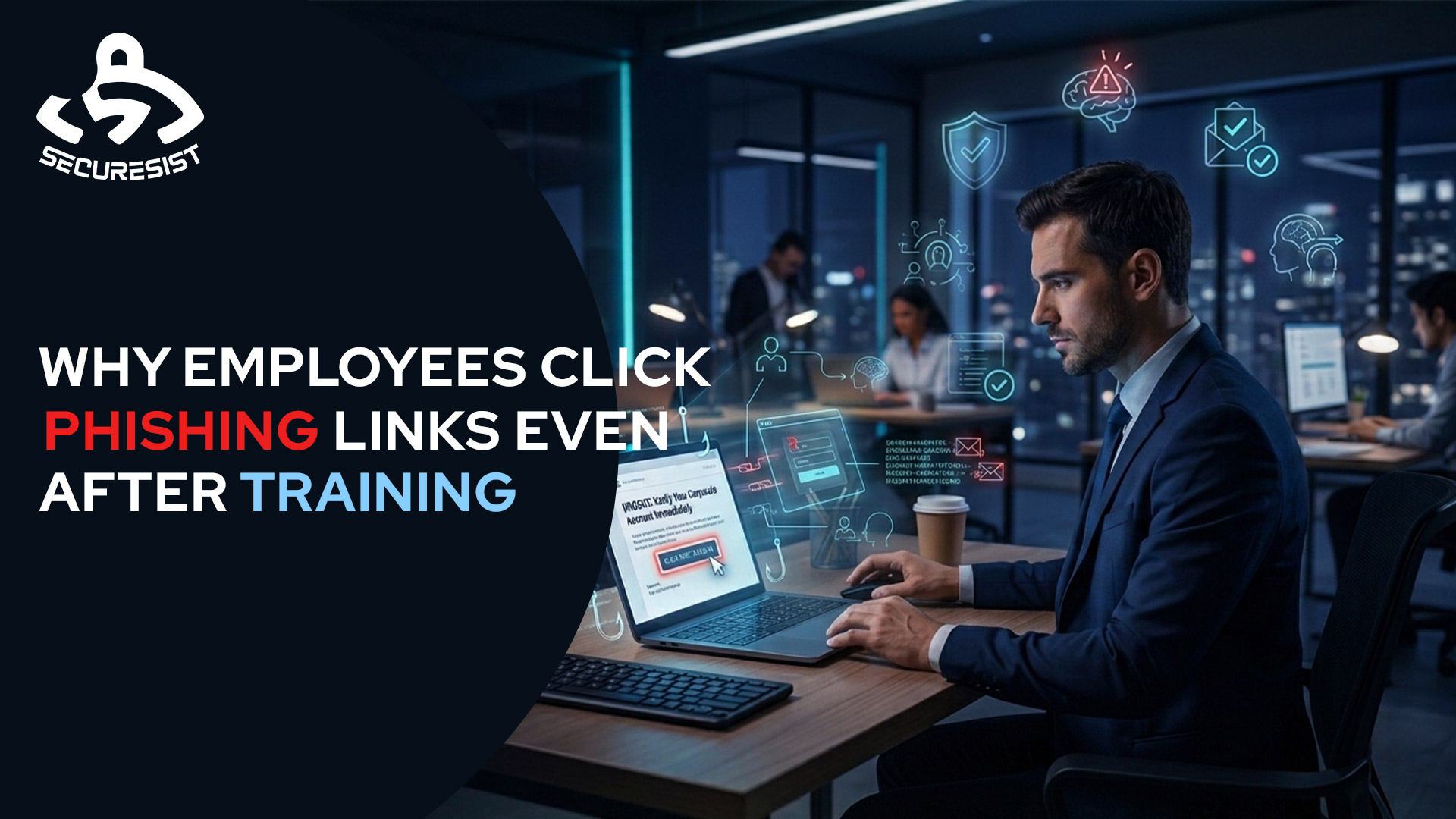
Phishing isn’t a new problem. Employees have been warned about suspicious emails for years, companies invest in training programs, and security teams regularly remind staff to think before they click. Yet phishing remains one of the biggest causes of data breaches worldwide. Industry reports estimate that billions of phishing emails are sent every day, and even businesses with mature security programs continue to experience successful attacks.
So, why employees click phishing links even after training remains a question many IT leaders, business owners, and security professionals struggle to answer. The answer has less to do with intelligence and far more to do with how people work. To understand it fully, it helps to look at human risk management — the discipline that examines why human decisions remain the most exploited vulnerability in cybersecurity, regardless of how much training organizations provide.
Employees rarely examine every email with complete focus. They’re responding between meetings, clearing crowded inboxes, helping customers, or racing to finish deadlines. Attackers understand this reality and design emails that fit naturally into an already busy workday. To reduce successful phishing attacks, it’s important to understand not only how phishing works, but also why normal human behavior often works in the attacker’s favor.
Why Phishing Awareness Training Doesn’t Always Work
Many businesses invest in phishing awareness training with the expectation that educated employees will automatically make safer decisions. While training is essential, it often teaches people what phishing looks like instead of preparing them for the conditions in which phishing actually happens. This is one of the most consistent patterns in why security awareness training programs fail — the gap between a quiet training session and a pressured workday is wider than most programs acknowledge.
Think about how most training sessions work. Employees watch videos, read slides, answer quizzes, and complete the course in a quiet environment with plenty of time to think. Real phishing emails arrive under completely different circumstances. They appear while someone is answering dozens of emails, rushing to join a meeting, or trying to finish work before the end of the day.
That difference matters.
Knowing the signs of a phishing email doesn’t guarantee someone will notice them when they’re under pressure. Information learned during a scheduled training session doesn’t always translate into better decisions during a stressful workday. This is why getting employees to take cybersecurity training seriously requires more than good content — it requires building habits that hold up under real working conditions.
Another challenge is that many awareness programs are treated as yearly compliance tasks. Employees complete the course, receive a certificate, and return to their normal routine. Over time, those lessons fade while everyday habits take over again. Without regular practice and reinforcement, security awareness becomes something people remember in theory but struggle to apply in the moment. Effective cybersecurity training for employees is continuous, not annual.
The Psychology Behind Why Employees Still Click
Successful phishing campaigns are built around human behavior rather than technical tricks. Cybercriminals know they don’t need to fool everyone. They only need one person to react before thinking. These techniques fall under what security researchers describe as social engineering — the manipulation of human psychology to bypass technical defenses.
One of the strongest triggers is urgency. An email claiming an account will be locked, a payment has failed, or payroll needs immediate confirmation creates pressure to act quickly. Under time constraints, people naturally prioritize speed over careful verification.
Authority is equally powerful. Messages that appear to come from a manager, executive, bank, or trusted vendor carry an automatic sense of credibility. Most people are conditioned to respond quickly to requests from someone they believe has authority, especially when the message feels routine.
Curiosity is another reliable tactic. Unexpected documents, bonus announcements, delivery notifications, or account alerts encourage recipients to click simply to find out what’s happening. Fear works in a similar way — emails warning about security issues, legal notices, or account suspension create anxiety that pushes people toward fast decisions instead of careful ones. Understanding link manipulation tactics helps employees recognize how even familiar-looking URLs can redirect them to fraudulent pages designed to harvest credentials.
Beyond emotions, there’s another challenge many people overlook. Employees spend the day making hundreds of decisions, switching between emails, meetings, chats, and projects. This constant mental effort creates cognitive overload, making it harder to evaluate every message with the same level of attention. As mental fatigue increases, people rely on familiar patterns instead of careful analysis. In phishing psychology, this is exactly what attackers hope for.
Why Even Smart Employees Fall for Phishing
It’s easy to assume that someone who clicks a phishing email simply wasn’t paying attention. In reality, many victims are experienced professionals who understand cyber risks and have completed multiple training sessions.
The difference is context.
A finance manager processing invoices, a salesperson responding to clients, or an HR professional reviewing applications may receive hundreds of legitimate emails every week. When a phishing message closely resembles their normal workflow, it doesn’t immediately stand out as suspicious.
People also tend to trust familiar systems. If an email reaches their inbox, many assume it has already passed security filters. This is partly why cloud email security is a critical technical control — but even the best filters cannot catch every attack, particularly spear phishing attempts that are carefully personalized to match an individual’s role, relationships, and daily routines.
This is why employees click phishing links even after training. It isn’t usually because they lack knowledge. More often, it’s because attackers understand how people think, how they work, and how easily everyday habits can outweigh even the best intentions.
Knowledge Doesn’t Equal Behaviour Under Pressure
One of the biggest misconceptions about cybersecurity is that once someone learns how to spot a phishing email, they’ll never fall for one again. In reality, that’s not how the human brain works.
Annual training may check a compliance box, but it doesn’t create lasting habits. This is directly connected to why security awareness training programs fail — the brain prioritizes information it uses frequently and lets the rest fade into the background. Employees don’t stop making mistakes because they watched a one-hour presentation six months ago. They improve when they’re given regular opportunities to practise what they’ve learned.
Now combine fading memories with a busy workday. An employee may already be dealing with:
- A full inbox waiting for responses
- Back-to-back meetings
- Customer requests
- Team messages on Slack or Microsoft Teams
- Tight project deadlines
Instead of carefully analysing every email, the brain begins taking shortcuts. Psychologists call these mental shortcuts heuristics. They’re useful because they help people work faster, but they also increase the chances of making quick decisions without noticing subtle warning signs. This is where decision fatigue comes into play. By the afternoon, an urgent-looking email requesting a password reset or invoice approval can seem completely routine. This is why security awareness training metrics that measure behavior — not just completion — are so important for understanding whether training is actually reducing risk.
That’s why companies seeing the best results don’t rely on annual awareness sessions alone. Instead, they reinforce learning through regular reminders, realistic phishing simulations, and short training exercises throughout the year. Repetition turns information into habit, and habits are far more reliable under pressure than memory alone.
Attackers Exploit Emotion, Not Ignorance
There’s a common belief that phishing victims lack technical knowledge. In reality, many successful attacks target experienced professionals who understand cybersecurity risks.
Attackers know they don’t need to outsmart people. They simply need to influence how people feel in a particular moment. Modern phishing campaigns are carefully designed to trigger emotional responses before logical thinking has a chance to catch up.
Some of the most effective emotional triggers include:
| Trigger | Why It Works | Example |
| Urgency | Encourages immediate action | “Your account will be locked today.” |
| Authority | Builds instant trust | Email appearing to come from the CEO or HR |
| Curiosity | Makes people want to know more | “Updated salary structure attached.” |
| Fear | Creates panic | “Suspicious login detected on your account.” |
| Reward | Appeals to excitement | “You’ve received a bonus” or “Claim your gift card.” |
These techniques have become even more convincing with the rise of artificial intelligence. Instead of sending poorly written emails full of spelling mistakes, criminals can now use AI tools to create messages that sound natural, professional, and relevant. AI also allows attackers to personalize messages at a much larger scale — combining public information from company websites, LinkedIn profiles, and social media to reference real colleagues, ongoing projects, or recent events. This is the reality behind today’s most dangerous phishing attacks targeting UAE businesses, where personalization and local context make messages even harder to question.
The threat doesn’t stop with email. Cybercriminals are beginning to use technologies such as voice cloning and deepfakes to strengthen phishing attempts. This shift explains why phishing attacks continue to evolve faster than traditional awareness programs — and why understanding what cyber risk actually looks like at the organizational level is essential for designing programs that keep pace with these threats.
The Five Psychological Triggers Phishing Attacks Use
Behind almost every successful phishing email is a psychological trigger designed to encourage fast decisions. While phishing campaigns vary, they usually rely on the same human behaviours.
| Psychological Trigger | What It Looks Like | Why People Respond |
| Urgency | Password expires today, payment required immediately | Pressure reduces careful thinking. |
| Authority | CEO request, HR notice, IT support message | People naturally trust authority figures. |
| Curiosity | Shared document, confidential report, updated policy | People click to satisfy curiosity before verifying. |
| Fear | Security alert, legal notice, account suspension | Anxiety encourages immediate action. |
| Reward | Bonus announcement, refund, prize notification | Attractive offers lower people’s guard. |
What makes these tactics effective isn’t that employees are careless. It’s that these emotions are part of everyday life.
- Someone rushing to finish payroll may respond to an urgent request without noticing a suspicious sender address.
- A new employee might trust an email that appears to come from IT because they’re still learning company processes.
- A finance executive expecting invoices all morning is less likely to question another payment request that looks familiar.
Context matters just as much as the email itself. That’s why the question isn’t simply why employees click phishing links even after training. A better question is whether the environment encourages people to slow down before acting. This is what separates organizations with a genuine cybersecurity culture from those where security is treated as a periodic compliance requirement.
Successful awareness programs don’t just teach employees what phishing looks like. They also help them recognize the emotional reactions that attackers intentionally try to create. Understanding the phishing failure rate by industry gives organizations useful context for where their workforce sits relative to sector benchmarks — and how much improvement a well-designed program can realistically achieve.
Is Your Team Practicing, or Just Learning?
The gap between knowing what phishing looks like and recognizing it under pressure is where most attacks succeed. Securesist’s phishing simulation programs give employees repeated, realistic practice — so that when a real attack arrives, the right response is already a habit. Find out how it works →
What Actually Helps Reduce Phishing Clicks?
If phishing continues to succeed despite regular training, the obvious question is: what actually works?
The answer isn’t more slides, longer videos, or tougher quizzes. The most successful companies focus on changing everyday habits instead of simply increasing knowledge. One of the most effective approaches is phishing simulations. Unlike traditional training, simulated phishing emails place employees in situations that closely resemble real attacks. Instead of memorizing warning signs, people learn to recognize suspicious messages while carrying out their normal work. Over time, those repeated experiences build confidence and improve decision-making.
Microlearning is another strategy that’s gaining popularity. Rather than asking employees to complete a lengthy course once a year, learning is delivered in short sessions that take only a few minutes to complete. These bite-sized lessons are easier to remember and fit naturally into a busy schedule. This approach is central to what the best security awareness training programs have in common — they treat learning as an ongoing habit, not an annual event.
Equally important is what happens after someone makes a mistake. Imagine an employee clicks on a simulated phishing email. Instead of receiving a warning or being singled out, they’re immediately shown what they missed and how to spot similar attempts in the future. That instant feedback helps reinforce the lesson while it’s still fresh.
A modern awareness program usually includes a combination of:
- Regular phishing simulations that reflect current attack techniques
- Short learning sessions spread throughout the year
- Immediate feedback after simulations
- Updated examples based on emerging phishing trends
- Continuous practice instead of one-time compliance training
These methods work because they prepare employees for real situations, not classroom scenarios. Organizations looking to formalize this should explore a structured security awareness training program that combines simulation, reinforcement, and behavioral measurement into one continuous cycle.
Build a Security Culture, Not Just a Training Program
Technology plays an important role in stopping phishing, but culture often determines how people respond when something suspicious slips through. Building a genuine cybersecurity culture in your company means creating an environment where asking questions is encouraged and reporting mistakes is seen as a contribution, not a failure.
In many workplaces, employees hesitate to report suspicious emails because they worry about wasting someone’s time or admitting they made a mistake. Unfortunately, that delay can give attackers more time to access systems and sensitive information.
Employees should feel comfortable saying:
- “This email doesn’t look right.”
- “Can someone verify this request?”
- “I clicked the link by mistake.”
The sooner someone speaks up, the faster the security team can investigate and limit potential damage. Leadership also influences how seriously people treat cybersecurity. When managers follow verification procedures themselves and openly discuss security practices, employees are far more likely to adopt those habits. This leadership dimension is a core part of building a long-term human risk strategy that changes behavior across the entire organization, not just among the most security-conscious employees.
Simple verification routines can prevent many phishing attempts from becoming successful attacks:
- Confirm unexpected payment requests by phone
- Verify changes to banking details through a trusted contact
- Double-check unusual login requests before entering credentials
- Report suspicious emails instead of deleting them quietly
Perhaps most importantly, avoid creating a culture of blame. Publicly criticizing employees who fall for phishing simulations often discourages reporting. When learning replaces blame, employees become active participants in protecting the business. Organizations that want to embed this mindset at scale should evaluate their current security awareness training providers to ensure their programs support psychological safety alongside technical awareness.
How to Measure Phishing Training Success
Completing a training course doesn’t automatically mean it was effective. The real measure of success is whether employee behaviour improves over time. Instead of tracking course completion alone, organizations should monitor the security awareness training metrics that actually matter:
| Metric | Why It Matters |
| Phishing click rate | Shows how many employees interacted with simulated phishing emails. |
| Reporting rate | Measures how often suspicious emails are reported to the security team. |
| Repeat failures | Identifies employees who may need additional guidance. |
| Reporting time | Indicates how quickly potential threats are reported after being received. |
These insights help security teams understand what’s working, where additional support is needed, and whether training is producing meaningful improvements rather than simply meeting compliance requirements.
Conclusion
Phishing doesn’t continue to succeed because employees are careless. It succeeds because attackers understand how people think, work, and make decisions under pressure. Understanding what phishing is and how it works is the starting point — but the organizations that reduce it most effectively go further, combining continuous training with realistic simulations, technical controls, and a culture that treats reporting as a strength rather than an admission of failure.
Training remains an essential part of any cybersecurity strategy, but lasting improvement comes from continuous learning, realistic practice, and regular reinforcement. When businesses focus on building secure habits instead of simply delivering information, they’re far more likely to reduce successful phishing attacks and create a workforce that’s prepared for today’s evolving threats. The ransomware training guide is a useful companion read for organizations that want to extend the same behavioral approach to one of the most damaging attack types that phishing typically enables.
Frequently Asked Questions
Why do employees still click phishing links after training?
Most employees don’t click because they lack knowledge. They click because phishing attacks exploit urgency, trust, distraction, and routine workplace behaviour — psychological triggers that operate faster than rational thinking. That’s why phishing simulations are more effective than lectures: they create muscle memory, not just awareness.
How often should phishing awareness training be conducted?
Annual training isn’t enough for most workplaces. Short learning sessions combined with regular phishing tests throughout the year are generally more effective at reinforcing secure habits and maintaining awareness between formal training events.
Do phishing simulations really work?
Yes. Well-designed phishing simulations give employees practical experience identifying suspicious emails and help reinforce good decision-making through immediate feedback. Organizations that run regular simulations consistently see lower click rates and higher reporting rates over time.
Can AI-generated phishing emails fool trained employees?
Yes. AI can produce convincing emails with natural language, accurate grammar, and personalized details pulled from public sources. These attacks are often much harder to identify than traditional phishing emails, making continuous awareness and verification habits more important than ever. Understanding spear phishing vs. phishing helps employees recognize when an attack has been specifically designed around their role or relationships.
Turn Security Awareness Into Lasting Behavior
Employee education alone isn’t enough to stop modern phishing attacks. Attackers don’t target ignorance — they target habits, pressure, and routine. The organizations that reduce phishing risk most effectively are the ones that replace annual training with continuous practice, immediate feedback, and a culture where reporting is celebrated, not punished.
Securesist’s Cyber Security Awareness Training platform combines ongoing learning, realistic phishing simulations, and measurable behavioral insights to reduce human cyber risk across your entire organization — not just among the employees who take training most seriously.
Here is what working with Securesist delivers:
- Realistic phishing simulations tailored to your industry and attack trends
- Role-based training content so each department learns the threats they actually face
- Immediate in-the-moment feedback that turns mistakes into lasting learning
- Behavioral reporting that shows risk reduction, not just completion rates
- A clear path from compliance training to a security culture that holds under pressure
The question isn’t whether your employees will be targeted. The question is whether they’ll be ready.