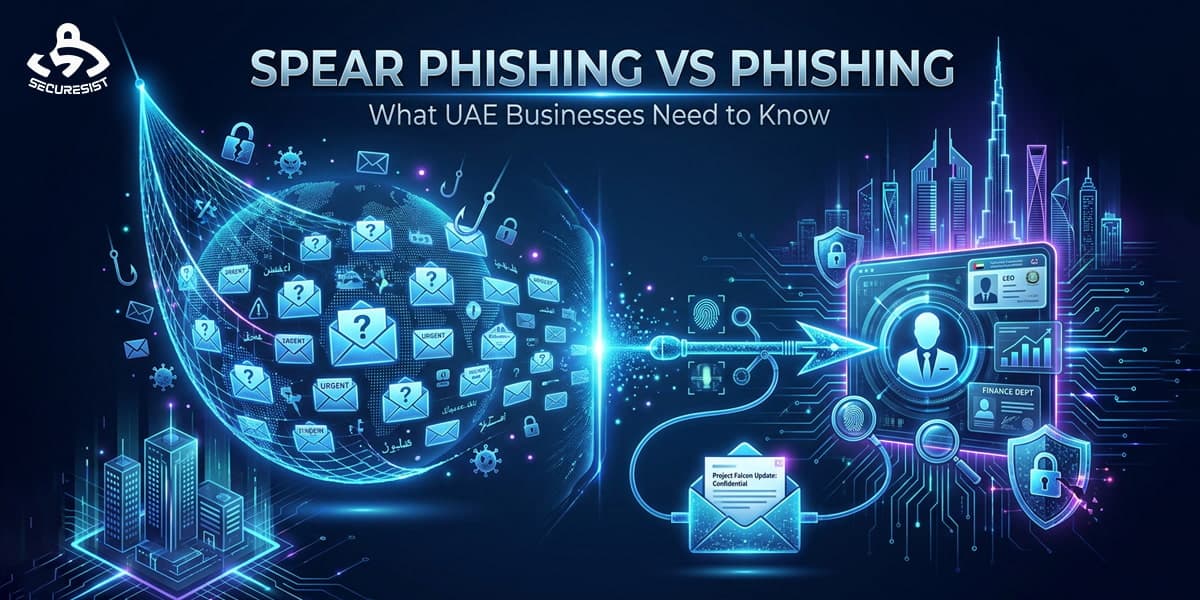
Cybercriminals are constantly refining their tactics. While traditional phishing attacks remain a common threat, many organizations are now facing a more dangerous variation called spear phishing.
At first glance, both attacks may look similar. They often arrive through email, create a sense of urgency, and attempt to trick recipients into revealing sensitive information or clicking malicious links. However, the way these attacks are planned and executed is very different.
Standard phishing campaigns focus on quantity. Attackers send the same message to thousands of people and hope a small percentage will respond. Spear phishing takes a completely different approach. Instead of targeting everyone, attackers focus on specific individuals, departments, or executives. They research their targets beforehand and create messages that appear legitimate and relevant.
For UAE businesses, this distinction matters. Organizations across sectors such as finance, healthcare, government services, logistics, and technology are increasingly being targeted through personalized cyberattacks. A single successful spear phishing attempt can lead to financial losses, data breaches, operational disruption, and reputational damage.
Understanding the differences between spear phishing and phishing is the first step toward building stronger defenses against these targeted attacks.
What Is Spear Phishing and Why Is It Far More Dangerous?
Phishing is a type of cyberattack that uses deceptive emails, messages, or websites to trick users into taking harmful actions. These actions may include sharing passwords, revealing financial information, downloading malware, or clicking malicious links.
Most phishing campaigns are designed for scale. Attackers distribute thousands of nearly identical messages to a large audience, hoping that some recipients will fall for the scam.
Spear phishing is much more focused.
Instead of targeting random users, attackers select specific individuals or organizations. They gather information about their targets and use that information to create highly convincing messages. These emails often include real names, job titles, company information, ongoing projects, or references to business relationships.
Because the communication appears familiar and relevant, victims are more likely to trust it.
The effectiveness of spear phishing comes from trust.
People are naturally cautious when they receive a generic email claiming they have won a prize or need to verify an account. However, they are far less suspicious when an email appears to come from a colleague, supplier, executive, or business partner.
Modern attackers understand this. Instead of trying to bypass technical security controls alone, they focus on manipulating human behavior.
This is why spear phishing continues to play a major role in business email compromise, financial fraud, credential theft, and data breaches worldwide.
Related Reading
• What is Phishing? Definition & How It Works
• What is Social Engineering in Cybersecurity?
• Link Manipulation: Common Tactics, UAE Threats & Prevention Tips
How Attackers Research UAE Executives and Employees Before Striking
Many successful spear phishing campaigns begin long before the first email is sent.
Attackers spend time gathering information about their targets. The more information they collect, the more convincing their messages become.
One of the most common sources of information is LinkedIn.
Executives, department heads, HR managers, finance professionals, and IT staff often share valuable details about their roles, responsibilities, achievements, and business activities. While these updates are useful for networking, they can also provide attackers with useful intelligence.
Company websites offer another source of information.
Leadership pages, employee directories, press releases, case studies, and partner announcements can reveal organizational structures and business relationships. Attackers use this information to understand who reports to whom and which employees may have access to sensitive systems or financial resources.
Social media platforms can further strengthen their research.
Posts about conferences, new projects, office expansions, vendor partnerships, or business events can provide context that helps attackers create believable scenarios.
In some cases, threat actors combine publicly available information with data obtained from previous breaches. This allows them to build detailed profiles of employees and executives.
A UAE-Based Example
Imagine a Dubai-based technology company announces a new partnership on LinkedIn.
A few days later, the finance department receives an email that appears to come from the new partner. The message references the recently announced collaboration and includes what looks like an invoice related to the project.
Everything appears legitimate.
The names are correct. The timing makes sense. The project mentioned is real.
However, the email was created by an attacker who used publicly available information to make the request appear trustworthy.
Without proper verification procedures, an employee may approve payment or open a malicious attachment without realizing they are being targeted.
This level of personalization is what makes spear phishing significantly more dangerous than traditional phishing attacks.

Real Examples of Spear Phishing Campaigns Targeting Organizations
Spear phishing attacks come in many forms, but most successful campaigns follow the same principle. Attackers exploit trust to gain access to money, credentials, or sensitive information.
Business Email Compromise (BEC)
Business Email Compromise is one of the most damaging forms of spear phishing.
In a BEC attack, cybercriminals impersonate executives, suppliers, vendors, or trusted partners. Their goal is usually financial gain.
An employee may receive an urgent request to process an invoice, update banking information, or transfer funds to a new account.
Because the request appears to come from a trusted source, it often bypasses normal suspicion.
Organizations worldwide continue to lose millions through these schemes every year.
CEO Fraud
CEO fraud is a specialized form of spear phishing that targets employees with financial authority.
An attacker impersonates a CEO, managing director, or senior executive and sends a message requesting an urgent payment or confidential information.
The request often includes language that discourages verification.
Employees may be told the matter is confidential or time sensitive.
Under pressure, they comply before confirming whether the request is genuine.
Credential Harvesting Attacks
Not all spear phishing attacks focus on money.
Many are designed to steal login credentials.
Employees receive emails directing them to what appears to be a legitimate login page for Microsoft 365, Google Workspace, or another business platform.
Once credentials are entered, attackers gain access to company accounts and can continue their attack from inside the organization.
The Facebook and Google Invoice Fraud Case
One of the most well-known examples involved a cybercriminal who impersonated a legitimate hardware vendor used by Facebook and Google.
Over several years, fraudulent invoices were sent to employees at both organizations.
The messages appeared authentic and referenced real business relationships.
As a result, the attacker successfully obtained more than $100 million through fraudulent payments before the scheme was uncovered.
The incident demonstrated that even large, sophisticated organizations can fall victim to carefully crafted spear phishing campaigns.
The Twilio Spear Phishing Incident
Twilio experienced a highly targeted attack in which employees received SMS messages that appeared to come from the company's IT department.
The messages directed users to a fake login page designed to capture credentials.
Several employees unknowingly entered their information, allowing attackers to gain access to internal systems.
The attack highlighted how modern spear phishing campaigns often combine email, text messages, fake websites, and social engineering techniques to increase their chances of success.
Related Reading
• Phishing Attacks: How Businesses in Dubai and the UAE Can Stay Protected
• What is Ransomware? How It Works & Types
• Privileged Identity Management: Securing Your Most Powerful Accounts
Why Generic Phishing Awareness Is Not Enough to Defend Against Spear Attacks
Many organizations conduct phishing awareness training once or twice a year.
While this is important, it often focuses on identifying obvious warning signs.
Employees are taught to look for poor grammar, suspicious links, unusual attachments, and generic greetings.
Unfortunately, modern spear phishing attacks rarely contain these indicators.
The messages are often professionally written. They may use correct branding, accurate job titles, legitimate business terminology, and information gathered from public sources.
To the recipient, the email feels normal.
Attackers understand workplace behavior. They know employees are busy. They know managers expect quick responses. They know finance teams process dozens of requests every day.
Instead of relying on technical tricks, they exploit trust and routine.
This is why traditional awareness training alone is no longer enough.
Organizations need employees to question unusual requests, even when they appear to come from trusted individuals. They must establish verification procedures for payments, account changes, and sensitive information requests.
Most importantly, businesses need to recognize that spear phishing is not simply a technology problem.
It is a human-focused attack that combines research, social engineering, and psychological manipulation to bypass traditional defenses.
How to Train Employees to Stop Personalized Phishing Attempts
Technology plays an important role in cybersecurity, but employees remain one of the strongest lines of defense against spear phishing attacks.
The challenge is that most attackers are no longer relying on obvious scams. They create messages that look legitimate, reference real business activities, and appear to come from trusted sources. This makes employee awareness more important than ever.
Use Role-Based Security Training
Not every employee faces the same level of risk.
A finance manager processes invoices and payment requests. An HR professional handles employee records and personal information. IT administrators have access to critical systems and accounts. Senior executives often become targets simply because of their authority within the organization.
Because of these differences, organizations should avoid a one-size-fits-all approach to security awareness.
Role-based training helps employees understand the specific threats they are most likely to encounter. Finance teams should learn how to identify fraudulent payment requests. HR departments should know how attackers attempt to steal employee information. Executives should understand the risks associated with business email compromise and executive impersonation.
The more relevant the training feels, the more effective it becomes.
Establish Verification Procedures
Many successful spear phishing attacks succeed because employees act quickly without verifying requests.
Attackers understand workplace pressure. They know people are busy and often expected to respond immediately.
That is why organizations should create clear verification procedures for sensitive actions.
For example:
• Confirm payment requests through a phone call.
• Verify changes to banking information through a trusted contact.
• Validate requests for confidential data before sharing information.
• Require additional approval for large financial transactions.
A simple verification process can stop an attack before any damage occurs.
Encourage Employees to Report Suspicious Emails
Employees should never feel hesitant about reporting something that looks unusual.
Sometimes an email may turn out to be legitimate. That is perfectly fine.
It is far better to investigate a harmless email than to ignore a genuine threat.
Organizations should make reporting simple and accessible. Security teams should also provide feedback when employees report suspicious messages. This helps reinforce positive behavior and encourages future reporting.
Build a Security-First Culture
Security awareness should not be treated as an annual compliance exercise.
Cyber threats evolve constantly. Employee awareness must evolve as well.
Organizations that build a strong security culture tend to perform better because employees actively participate in protecting the business.
This means:
• Sharing threat updates regularly.
• Discussing recent phishing trends.
• Recognizing employees who identify threats.
• Encouraging questions about suspicious communications.
When security becomes part of daily operations rather than an occasional training session, employees are more likely to recognize and respond to spear phishing attempts.
Related Reading
• Cybersecurity Training for Employees: Building a Human-Centered Defense
• Best Security Awareness Training: Building a Human-First Cyber Defense
• Data Security Awareness Training: Strengthening Your First Line of Defense
• How to Build a Human Risk Strategy for the Future
• Human Risk Management: The Missing Layer in Cybersecurity
How Spear Phishing Simulations Differ From Standard Phishing Campaigns
Many organizations use phishing simulations to measure employee awareness. These exercises provide valuable insight into how employees respond to suspicious messages in a controlled environment.
However, not all simulations are created equal.
Standard Phishing Simulations
Traditional phishing simulations are designed to replicate common phishing scams.
Employees might receive messages claiming:
• A password has expired.
• A package delivery failed.
• An account requires verification.
• A gift card has been won.
These exercises help employees identify basic phishing tactics and reinforce fundamental security awareness concepts.
They are useful, especially for organizations that are beginning to build cybersecurity awareness programs.
Targeted Spear Phishing Simulations
Spear phishing simulations take things a step further.
Instead of sending generic messages, security teams create realistic scenarios based on actual business processes.
For example, a finance employee might receive a simulated invoice request from a supplier. An HR professional could receive a message requesting employee records. A department manager may receive an email appearing to come from a senior executive.
These exercises mirror the tactics used in real-world attacks.
Because the scenarios feel realistic, they provide a more accurate picture of how employees might respond during an actual incident.
Benefits for UAE Businesses
Organizations across the UAE operate in highly connected and fast-moving business environments.
Employees regularly communicate with suppliers, government entities, clients, partners, and remote teams. This creates opportunities for attackers to exploit trust and impersonate legitimate contacts.
Targeted phishing simulations help businesses:
• Identify vulnerable departments.
• Measure employee readiness.
• Improve incident reporting.
• Strengthen verification procedures.
• Reduce the likelihood of successful attacks.
Rather than waiting for a real incident to expose weaknesses, organizations can uncover and address gaps proactively.
Related Reading
• What is a Phishing Simulation & How to Prevent Attacks
• Phishing Test: How to Assess Your Employees' Security Awareness
• What is the Phishing Failure Rate by Industry? Benchmarks & Best Practices
• Security Awareness Training Metrics That Matter
Best Practices for UAE Businesses to Reduce Spear Phishing Risk
There is no single solution that completely eliminates spear phishing risk.
The most effective defense combines employee awareness, strong security controls, and well-defined processes.
Enable Multi-Factor Authentication (MFA)
Passwords alone are no longer enough.
If attackers obtain login credentials through a spear phishing attack, MFA provides an additional layer of protection.
Even when a password is compromised, attackers must still complete an additional verification step before accessing the account.
This simple measure significantly reduces the risk of account compromise.
Implement SPF, DKIM, and DMARC
Email authentication plays a critical role in preventing email spoofing and domain impersonation.
SPF (Sender Policy Framework) helps identify which servers are authorized to send emails on behalf of your domain.
DKIM (DomainKeys Identified Mail) verifies that email content has not been altered during transmission.
DMARC (Domain-based Message Authentication, Reporting, and Conformance) builds on SPF and DKIM by allowing organizations to define how unauthenticated emails should be handled.
Together, these technologies help reduce the effectiveness of phishing campaigns that rely on impersonating legitimate business domains.
Use Advanced Email Security Gateways
Modern email security solutions can identify and block many phishing attempts before they reach employee inboxes.
These tools analyze:
• Sender reputation
• Suspicious links
• Malicious attachments
• Behavioral indicators
• Domain impersonation attempts
While no solution catches every threat, advanced email filtering significantly reduces exposure.
Adopt a Zero Trust Approach
Traditional security models often assume users and devices inside the network can be trusted.
Zero Trust operates differently.
Every access request must be verified regardless of where it originates.
This approach limits the damage attackers can cause if they successfully compromise an account through spear phishing.
Develop an Incident Response Plan
Even organizations with strong security controls may eventually experience an attempted attack.
Preparation matters.
An incident response plan helps teams act quickly and consistently when suspicious activity is detected.
A well-developed plan should define:
• Reporting procedures
• Investigation steps
• Containment measures
• Communication responsibilities
• Recovery processes
When employees know exactly what to do, response times improve and business disruption is minimized.
Related Reading
• Top Cybersecurity Tools to Protect Your Organization in 2026
• Security Awareness Training Providers: Strengthening Your Human Firewall
• HRM Platform: Transforming Workforce Management in the Digital Era
Conclusion
Spear phishing and phishing may belong to the same family of cyber threats, but they present very different levels of risk. Traditional phishing attacks rely on volume and broad distribution. Spear phishing focuses on precision, personalization, and trust.
For UAE businesses, this distinction is becoming increasingly important. Attackers are using publicly available information, social engineering techniques, and sophisticated impersonation tactics to target employees, executives, and business partners with remarkable accuracy.
Protecting against these threats requires more than basic awareness training. Organizations need a layered security strategy that combines employee education, strong authentication controls, email security technologies, phishing simulations, and well-defined response procedures.
The good news is that most successful spear phishing attacks can be prevented. With the right combination of people, processes, and technology, businesses can significantly reduce their exposure to targeted attacks and strengthen their overall cybersecurity posture.
FAQs
What is an example of spear phishing?
An example of spear phishing is an email that appears to come from a company executive requesting an urgent fund transfer or confidential information. The message is personalized and often includes real names, job titles, or project details to appear legitimate.
What is the main difference between phishing and spear phishing?
Phishing targets a large number of users with generic messages, while spear phishing targets specific individuals or organizations using personalized information gathered through research.
What are four types of phishing?
Four common types of phishing include email phishing, spear phishing, whaling, and smishing. Each method uses different techniques to trick victims into revealing sensitive information or taking harmful actions.
What are the characteristics of spear phishing?
Spear phishing attacks are highly targeted, personalized, research-driven, and designed to appear trustworthy. They often impersonate colleagues, executives, vendors, or business partners.
What protects users from spear phishing?
Security awareness training, multi-factor authentication (MFA), email security solutions, verification procedures, and strong email authentication protocols such as SPF, DKIM, and DMARC help protect users from spear phishing attacks.
How does spear phishing differ from pretexting?
Spear phishing primarily uses emails or digital messages to deceive victims, while pretexting involves creating a fabricated scenario or identity to gain trust and extract information. Spear phishing often incorporates pretexting techniques as part of the attack.